


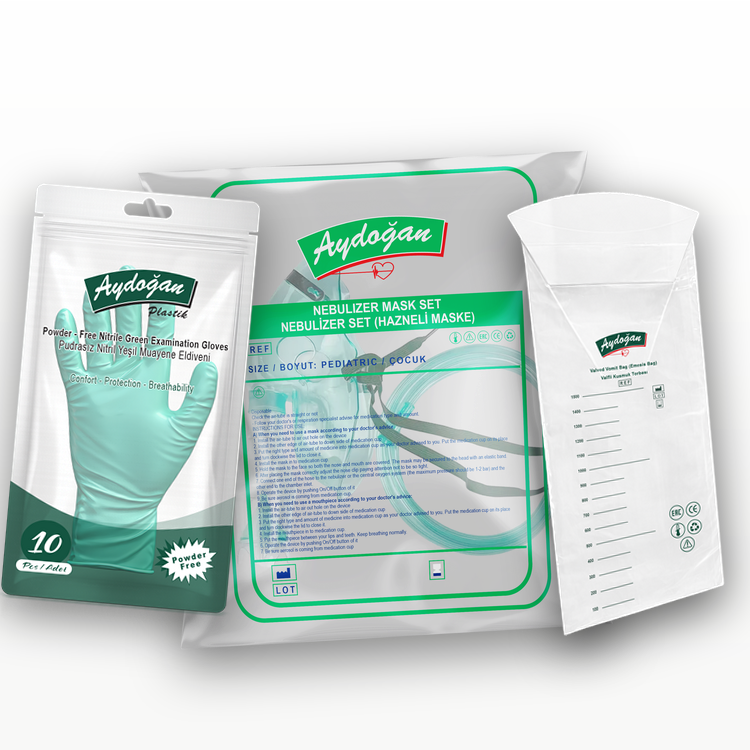
Application Areas
- Medical and surgical mask packaging
- Disposable examination gowns and caps
- Sterile single-use medical equipment
- Cotton, gauze and dressing materials
- Syringe, needle and catheter packaging
- Hospital and clinic consumables
- Home care and first-aid product sets
Packaging Formats
- Pillow / flowpack single-product packs
- Hang-hole retail pouches
- Bottom/side gusseted sterile bags
- Leak-Proof Triangular Vomit Bag
- Stand-up doypack premium presentation
- Reel-form film (for automatic filling)
- Reclosable zipper set bags
Seal and film performance maintains integrity after sterilisation.
Film & Material Options
- Multi-layer coex film structure for medical-grade applications
- Glossy and matte finish packaging options
- Matte outside and glossy inside surface structure
- PET/CPP retortable reel film for sterilization-ready packaging with high puncture resistance
- Soft touch, Flexible and rigid materials
- PET/PE – barrier for extended shelf life
- PET/MET.PET/PE – metallised structures for long term barrier
- Up to 8-colour flexo printing – custom design
Raw material selection compliant with ISO 11607 medical packaging standards.
Medical Packaging: Sterile-Barrier Polyethylene Solutions for Healthcare Products
From single-use surgical drapes and examination gloves to catheter kits and wound dressing sets, the medical device and consumable sector demands packaging that guarantees sterility, provides tamper evidence, and meets a complex web of regulatory requirements across every market it enters. Medical packaging in polyethylene film format serves as the primary sterile barrier for non-woven medical products, disposable healthcare consumables, and ancillary clinical supplies. Unlike general-purpose packaging, healthcare product packaging operates under a zero-tolerance quality paradigm: a single compromised seal can render an entire product batch non-sterile and unsaleable.
Aydoğan Plastik manufactures polyethylene-based medical device wrapping films and bags designed for the healthcare sector’s uncompromising quality standards. Our film extrusion lines produce multi-layer films with the controlled cleanliness, consistent seal properties, and regulatory-grade traceability that clinical supply bags and hospital packaging applications demand.
Applications Across the Healthcare Sector
Disposable Medical Consumables
Single-use examination gloves, surgical masks, gowns, drapes, shoe covers, and bouffant caps are high-volume medical consumables packaged in polyethylene bags or wrapping films. These products are typically non-sterile but must be protected from environmental contamination—dust, moisture, and handling soil—until the point of use. Our medical supply pouch films provide an effective contamination barrier with consistent seal performance on high-speed dispensing and auto-bagging lines used by medical consumable manufacturers.
Pack formats range from individual unit wraps (single glove pairs, single mask packs) to bulk dispenser boxes containing 50–200 units in an inner PE liner bag. Our films handle both extremes: ultra-thin gauges (20–30 microns) for lightweight individual wraps and heavier constructions (50–70 microns) for bulk liner applications where tear resistance and static load performance are critical.
Sterile Medical Device Packaging
Medical devices that require sterile presentation—wound dressings, catheter insertion kits, IV start kits, surgical instrument trays—demand packaging that maintains a sterile barrier from the sterilisation event through storage, distribution, and the moment of clinical use. Our PE films serve as the sealable layer in peelable sterile barrier packaging systems, where a Tyvek or medical-grade paper top web is heat-sealed to a PE bottom web to create a peelable pouch. The seal must be strong enough to maintain sterility during handling yet peel cleanly without fibre tear or particulate generation when opened in the operating theatre.
Controlled peel-seal formulations are critical for this application. Our seal-layer resins are selected to deliver a specific peel-force window—typically 1.5 to 3.5 N/15 mm—that healthcare professionals can open consistently and confidently with gloved hands. Quality control testing measures peel force on every production batch using calibrated tensile testing equipment.
Wound Care and Dressing Packaging
Adhesive bandages, gauze pads, hydrocolloid dressings, and compression bandage rolls are packaged in PE bags and flow-wrap films that protect against moisture ingress and contamination. For individually wrapped sterile dressings, our thin-gauge films deliver the tight, form-fitting wrap that keeps the dressing compressed and protected within its sterile envelope. For multi-count wound care packs (first aid kits, clinic supply packs), our heavier-gauge films provide the tear resistance and seal durability needed for packs that may be opened and reclosed multiple times during their service life.
Diagnostic and Laboratory Product Packaging
Diagnostic test kits, specimen collection containers, laboratory reagent packs, and point-of-care testing devices require packaging that protects sensitive components from moisture, light, and temperature extremes during distribution. Our multi-layer films can incorporate enhanced moisture-barrier properties for humidity-sensitive diagnostic reagents and opaque layers for light-sensitive components. Lot traceability requirements are met through printed lot codes, manufacturing date stamps, and expiry date windows integrated into the packaging design.
Orthopaedic and Implant Ancillary Packaging
While implantable devices themselves are packaged in rigid tray systems, the ancillary components—surgical drapes, instrument pouches, fluid collection bags, and procedure kits—are frequently packaged in PE-based flexible formats. These ancillary packs must match the sterility assurance level of the primary device packaging, requiring the same controlled seal performance, batch traceability, and regulatory compliance. Our production systems deliver this level of quality consistently across long production campaigns.
Technical Specifications
Film Thickness and Material
Medical packaging films range from 20 to 80 microns. Individual product wraps use 20–35 microns, sterile barrier pouches 35–55 microns, and bulk liner bags 55–80 microns. Our co-extrusion lines produce multi-layer structures where the seal layer provides controlled peel performance, the core layer delivers mechanical integrity, and the outer layer supports printing and identification requirements.
All medical packaging films are produced from virgin-grade resins under controlled manufacturing conditions. Material certificates, batch traceability records, and biocompatibility documentation are maintained for every production lot.
Controlled Peel-Seal Technology
The ability to produce seals with a specific, repeatable peel-force range is the defining technical capability in medical packaging. Our seal-layer formulations are engineered to deliver consistent peel behaviour across the full production run—not just on test samples but on every bag in every box. This consistency is achieved through precise resin selection, tight extrusion process controls, and rigorous statistical process monitoring in our quality control programme.
Cleanliness and Particulate Control
Medical packaging production demands a level of process cleanliness that exceeds general packaging standards. Our production environment implements controlled material handling procedures, dedicated equipment for medical-grade production runs, and particulate monitoring protocols. These measures ensure that films leaving our facility meet the cleanliness expectations of medical device manufacturers whose own quality systems are audited by regulatory authorities.
Printing and Identification
Up to 8-colour flexo printing delivers the regulatory information, product identification, and brand communication that medical packaging requires. Lot numbers, expiry dates, sterilisation method indicators, storage condition icons, and regulatory compliance marks are printed with the precision and legibility that healthcare professionals depend on for safe product use. Our graphic design team ensures layouts comply with medical device labelling regulations across target markets. Lamination protects printed information from abrasion during handling and storage.
Production Process
Our ISO-certified facility manages the complete medical packaging production chain with full batch traceability. Film extrusion produces medical-grade base films, printing applies identification and branding, slitting prepares reels, and cutting produces finished formats. Every batch undergoes quality control testing for peel force, seal strength, dimensional accuracy, and cleanliness. Products ship from warehousing and shipping with full batch documentation. Visit about us or contact us for technical consultation.
Frequently Asked Questions
Are the films produced from virgin-grade materials?
Yes, all product-contact layers use virgin-grade resins with full material certificates and batch traceability documentation.
Can lot numbers and expiry dates be printed on the packaging?
Yes, printed lot codes, date stamps, sterilisation indicators, and regulatory marks are standard. Variable data areas for customer-applied coding are incorporated into the design.
Is the production environment controlled for cleanliness?
Yes, dedicated medical-grade production protocols, controlled material handling, and particulate monitoring ensure film cleanliness meets healthcare sector expectations.
What film thickness is recommended for medical packaging?
20–35 microns for individual wraps, 35–55 microns for sterile pouches, and 55–80 microns for bulk liner bags.
What is the minimum order quantity?
Varies by format, thickness, and print specifications. Medical packaging runs require dedicated production scheduling. Contact our team for project-specific details and qualification timelines.