


Application Areas
- Plastic granulate and PE/PP raw material packaging
- Cement, lime and construction powder packaging
- Chemical and mineral powder raw material packs
- Industrial pigment and additive raw material bags
- Bulk food powders (industrial flour, sugar, milk powder)
- Animal feed and pet food raw material bags
Technical Features
- Capacity from 5 kg up to 30 kg
- Heavy-duty tensile and puncture resistance
- Form-fill-seal (FFS) reel production compatibility
- Micro-perforated structures for de-aeration and dust control
- Antistatic additive film option
- Anti-Slip Plastic Resin Bags for Safe Palletizing
- Embossed PE Resin Bags to Prevent Pallet Slippage
Antistatic additive films meet safety standards for statically-charged powdered products.
Film & Material Options
- LDPE / LLDPE — tensile resistance, FFS compatibility
- MDPE — high strength at economical gauge
- HDPE — thin film high load-bearing
- CoEx (multi-layer) films — puncture resistance
- Antistatic additive films — chemical and pigment raw materials
- Up to 8-colour flexo printing — product, batch and hazard information
- PCR (Post-Consumer Recycled) and PIR (Post-Industrial Recycled) raw materials – sustainable production
In form-fill-seal (FFS) reel production, thickness consistency and seal performance are critical.
Raw Material Plastic Bags & Bulk Powder Packaging: Heavy-Duty PE Sacks for Industrial Granules and Powders
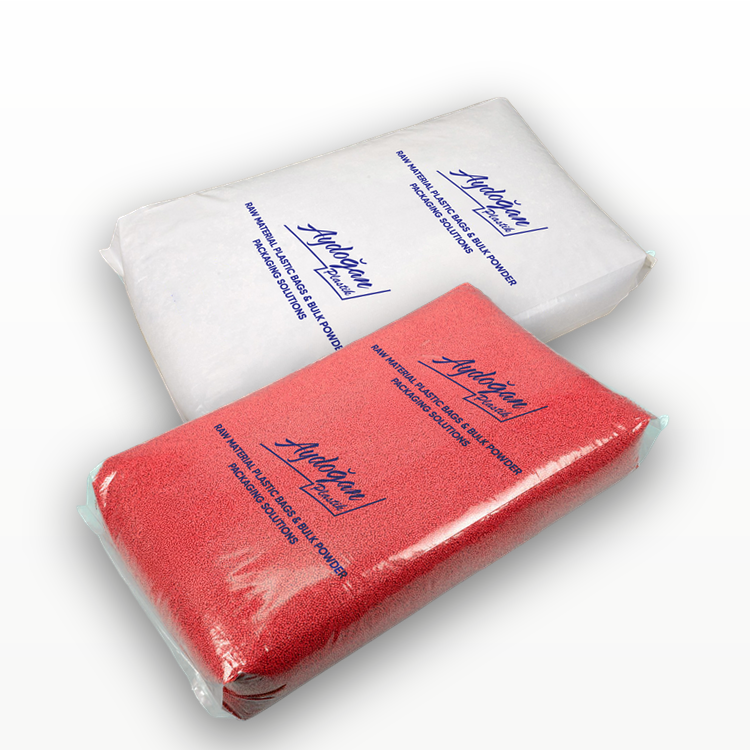
Plastic manufacturing begins with raw materials—virgin polymer granules, recycled flake, masterbatch concentrates, additive powders, and compounded pellets—that must be packaged, transported, and stored without contamination, moisture absorption, or mechanical degradation. Raw material plastic bags are the standard containment format for these industrial inputs, providing a sealed polyethylene barrier that protects granule surface quality, prevents dust emission, and maintains the material purity that downstream processing equipment demands. Beyond the plastics industry, identical bulk powder packaging requirements exist across chemicals, minerals, food ingredients, and pharmaceutical intermediates—any sector where free-flowing granules or powders are moved in 10–30 kg bags through industrial supply chains.
Aydoğan Plastik manufactures heavy-gauge polyethylene polymer granule sack and industrial powder bag products on film extrusion lines engineered for the thick-gauge, wide-format output these demanding applications require. Our resin packaging bag and bulk material liner products serve the plastics, chemical, mineral, and food-ingredient sectors with films that deliver the puncture resistance, moisture barrier, and seal reliability that heavy industrial granule and powder containment demands.
Applications Across Industrial Raw Material Handling
Virgin Polymer Granules
PE, PP, PET, PA, ABS, and speciality engineering polymer granules are packaged in 25 kg PE sacks at the resin production plant and shipped to converters, moulders, and extruders worldwide. The packaging must protect granule surfaces from scratching, moisture absorption, and dust contamination—any surface defect on a granule can become a visible defect in the final moulded or extruded product. Our films provide the clean, smooth inner surface that prevents granule surface marking, combined with the moisture barrier that keeps hygroscopic polymers (nylon, PET, TPU) dry enough for immediate processing without pre-drying.
Automated bag-filling lines at polymer plants operate at high speed, requiring films with consistent thickness, controlled slip, and reliable seal performance at filling rates of 10–20 bags per minute. Our films are qualified on the major bag-filling equipment platforms used by global resin producers, ensuring trouble-free integration into existing production workflows.
Recycled Plastic Flake and Regrind
Recycled PET flake, HDPE regrind, PP reclaim, and mixed-plastic recyclate are packaged for sale to processors who convert them back into products. These recycled materials are typically denser and more irregularly shaped than virgin granules, creating sharper stress concentrations against the bag walls. Our LLDPE-enriched films provide the enhanced puncture resistance needed for recycled materials with rough, angular particle shapes that would puncture standard-gauge bags.
Masterbatch and Colour Concentrates
Colour masterbatch, additive concentrates, and processing aids are high-value products where cross-contamination between colours or additive types is unacceptable. Each bag must provide complete product isolation—any residual granules from a previous batch clinging to the bag interior could contaminate a colour-critical production run at the converter’s facility. Our films deliver the clean inner surfaces and reliable full-bag evacuation that masterbatch producers require to maintain colour purity and additive accuracy across their product range.
Mineral Powders and Fillers
Calcium carbonate, talc, kaolin, silica, titanium dioxide, and other mineral powders used as fillers, reinforcements, and functional additives in plastics, paints, and coatings are packaged in PE bags and liners. These ultra-fine powders migrate into every gap, including seal zones, creating the same contamination-tolerant sealing challenges encountered in flour and cement packaging. Our seal formulations deliver reliable hermetic closures despite fine mineral dust in the seal area, preventing the product leakage and dust emission that compromise workplace air quality and create material waste.
Food Ingredient Powders and Granules
Sugar, salt, starch, flour, milk powder, and protein concentrates are packaged in food-grade PE bags and liners for delivery to food manufacturers. These applications combine the mechanical demands of heavy industrial packaging with the hygiene and regulatory requirements of the food sector. Our food-grade raw material bags are produced from certified resins with full traceability documentation, providing food manufacturers with the supply-chain assurance their quality systems require.
Pharmaceutical Intermediates
API intermediates, excipient powders, and pharmaceutical processing aids are packaged in PE liners within drums or IBCs. These applications demand the highest levels of production cleanliness, batch traceability, and material documentation. Our pharmaceutical-designated production runs maintain the controlled conditions and comprehensive documentation that pharmaceutical supply chains audit and verify.
Technical Specifications
Film Thickness and Material
Raw material and bulk powder bags range from 60 to 150 microns. Standard 25 kg granule sacks use 60–90 microns, heavy-duty powder bags 80–120 microns, and extra-heavy bulk sacks 120–150 microns. Our co-extrusion lines produce multi-layer structures with smooth inner surfaces for granule protection, strong core layers for mechanical performance, and printable outer layers for product identification.
LLDPE is the dominant resin for heavy industrial bags, providing the puncture, tear, and elongation performance that granule and powder containment demands. HDPE blends add stiffness and moisture barrier for hygroscopic materials. Virgin resins are standard for food and pharmaceutical applications; recycled content is available for industrial-grade products.
Moisture Barrier
Hygroscopic polymers (nylon, PET, EVOH) and moisture-sensitive powders require low-MVTR packaging to prevent quality degradation during storage and transport. Our films deliver controlled moisture barrier performance calibrated to each product’s sensitivity, with quality control MVTR testing on every production batch.
Seal Strength and Filling-Line Compatibility
Industrial bag-filling lines seal bags immediately after filling, often with product dust present in the seal zone. Our contamination-tolerant seal formulations deliver reliable closures under these challenging conditions. Seal width, temperature, and pressure parameters are matched to each customer’s filling equipment for optimised production-line integration.
Pallet Stacking and Warehouse Storage
Filled raw material bags are palletised and stacked 3–5 layers high in warehouses, placing sustained compressive load on bottom-layer bags for weeks or months. Our films and seal constructions are tested for creep resistance under simulated stacking conditions that replicate worst-case warehouse loading scenarios, ensuring bottom-layer bags maintain integrity throughout the storage period.
Printing and Identification
Up to 8-colour flexo printing delivers product identification, batch codes, material grade specifications, safety data references, and brand logos on raw material bags. Our graphic design team ensures label layouts meet industry identification standards and customer-specific formatting requirements. Lamination protects print from the abrasion and moisture exposure typical in industrial storage environments.
Production Process
Our integrated facility manages the complete workflow: extrusion, printing, slitting, and cutting with reinforced seal construction. Every batch passes quality control testing for thickness, puncture resistance, MVTR, seal strength, and inner-surface cleanliness. Production waste is recycled via our recycling facility. Products ship from warehousing and shipping. Visit about us or contact us for technical consultation and filling-line compatibility assessment.
Frequently Asked Questions
What film thickness is used for raw material bags?
60–90 microns for standard 25 kg granule sacks, 80–120 microns for heavy powders, and 120–200 microns for extra-heavy sacks.
Are food-grade raw material bags available?
Yes, produced from certified food-contact resins with full traceability documentation for food-ingredient supply chains.
Can powder dust in seals cause leakage?
No, contamination-tolerant seal formulations deliver hermetic closures despite fine powder in the seal zone.
Is printing available for product identification?
Yes, up to 8-colour flexo with batch codes, grade specs, and safety references. Lamination for warehouse durability.
What is the minimum order quantity?
Varies by bag dimensions, gauge, and application (food, pharma, industrial). Contact our team for project-specific quotes.