


Application Areas
- Hospital and clinic medical waste collection
- Laboratory and research waste packaging
- Dialysis unit and blood centre waste
- Veterinary and animal health waste
- Chemical and hazardous material waste packaging
- Pharmacy and pharmaceutical disposal packaging
- Municipal medical waste collection bags
Technical Features
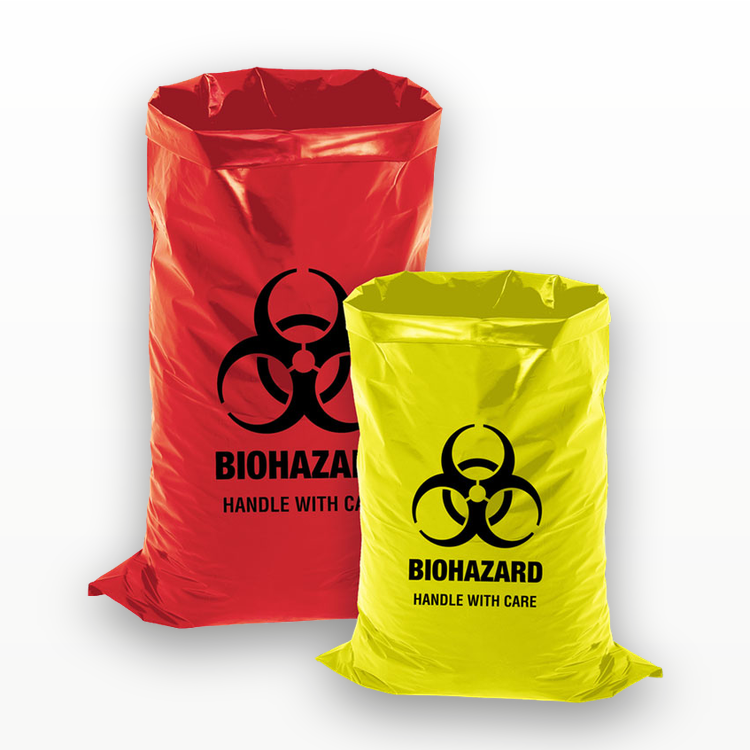
- Standard red, yellow and purple colour coding
- UN-certified hazardous material packaging compliance
- Biohazard and cytotoxic symbol printed structures
- Double-layer reinforced seal welding
- Leak-proof and puncture-resistant structure
- Drawstring or flat-mouth closure system
UN-certified production and test reports can be provided in accordance with waste regulations.
Film & Material Options
- LDPE / LLDPE — flexible, puncture-resistant structure
- MDPE — high strength, economical gauge
- CoEx multi-layer structures — high-security applications
- Antistatic additive films — chemical waste applications
- Up to 8-colour flexo printing — biohazard and UN symbols
- PCR (Post-Consumer Recycled) and PIR (Post-Industrial Recycled) raw materials – sustainable production
Opaque coloured structures in medical waste bags fully conceal contents from outside view.
Chemical Bags: Resistant Polyethylene Packaging for Hazardous and Industrial Chemicals
Chemical products—from corrosive industrial reagents and powdered detergent intermediates to agricultural pesticides and pharmaceutical raw materials—demand packaging that goes far beyond basic containment. Chemical bags must resist aggressive chemical interactions between the product and the film, prevent leakage that could endanger workers and contaminate environments, comply with strict hazardous-goods transport regulations, and communicate safety information clearly through durable printed labels and colour-coded identification systems. Failure in any one of these areas can result in environmental contamination, workplace injury, regulatory penalties, and costly product loss.
Aydoğan Plastik manufactures polyethylene-based chemical resistant sack products engineered for the demanding requirements of industrial chemical containment. Our film extrusion lines produce multi-layer films with the hazardous material bag performance characteristics—chemical inertness, mechanical toughness, and regulatory-grade traceability—that industrial chemical packaging and corrosion-proof poly bag applications demand.
Applications Across the Chemical Industry
Powdered Industrial Chemicals
Soda ash, caustic soda flakes, calcium chloride, sodium bicarbonate, and industrial-grade cleaning agents are packaged in thick-gauge PE bags that resist the alkaline and acidic chemistry of their contents. Our chemical containment liner films are formulated for zero migration interaction with aggressive powder chemistries, maintaining film integrity across storage periods that may extend to 12 months or longer in uncontrolled warehouse environments. Multi-layer LLDPE structures provide the puncture resistance needed for dense, crystalline powder products that concentrate stress at sharp grain-to-film contact points.
For hygroscopic chemical powders that absorb atmospheric moisture, our films deliver low MVTR values that keep products dry and free-flowing throughout their storage life. Moisture-contaminated chemical powders can harden, cake, or initiate unwanted chemical reactions—failures that our barrier films are specifically designed to prevent.
Agricultural Chemicals
Pesticide powders, herbicide granules, fungicide formulations, and agricultural adjuvants require packaging that isolates aggressive active ingredients from the external environment while protecting handlers from chemical exposure during transport and storage. Our agricultural chemical bags use formulations tested for compatibility with specific crop-protection chemistries, ensuring no plasticiser extraction, film swelling, or barrier degradation occurs during the product’s shelf life. UN-rated bag constructions are available for products classified as dangerous goods under international transport regulations.
Pharmaceutical and Cosmetic Raw Materials
Active pharmaceutical ingredients (APIs), excipients, and cosmetic raw materials require packaging with controlled cleanliness levels, full batch traceability, and regulatory-grade documentation. Our PE liners for pharmaceutical chemical drums and intermediate bulk containers (IBCs) provide an inert, contamination-free barrier between the product and its outer container. Virgin-grade resins with complete material safety documentation ensure compliance with pharmaceutical supply-chain quality requirements.
The pharmaceutical chemical segment demands the most rigorous documentation standards in the packaging industry. Every raw material lot must be traceable to its resin supplier, every production parameter must be recorded and archived, and every finished bag must be identifiable by batch number for post-delivery quality investigations. Our production management systems deliver this level of traceability as standard for pharmaceutical-designated production runs, with certificates of analysis accompanying every shipment.
Laboratory and Research Chemicals
Research institutions, university laboratories, and analytical testing facilities use PE bags and liners for sample containment, reagent storage, and waste collection. These applications prioritise chemical purity—any extractable or leachable compound from the packaging could contaminate experimental results. Our laboratory-grade PE films are produced from resins with documented extractable profiles, providing the analytical confidence that research applications demand.
Hazardous Waste Collection
Chemical waste from manufacturing, laboratory, and remediation operations is collected in colour-coded PE bags that identify the waste category for safe handling and compliant disposal. Our hazardous waste bags are produced in the specific gauges, colours, and print formats that environmental regulations mandate. Bags for chemical waste typically require heavier gauges (100–200 microns) than standard waste bags, with enhanced puncture and tear resistance that prevents rupture during the handling and transport of chemical-contaminated materials.
Technical Specifications
Film Thickness and Material
Chemical bag films range from 60 to 200 microns depending on the application and product aggressiveness. Standard powder chemical bags use 60–100 microns, heavy-duty sacks for dense crystalline products 100–150 microns, and hazardous waste containment bags 150–200 microns. Our co-extrusion lines produce multi-layer structures where the inner layer provides chemical resistance and product compatibility, the core layer delivers mechanical strength, and the outer layer supports printing and identification requirements.
LLDPE is the primary resin for chemical bag applications, providing superior puncture resistance and elongation. HDPE blends add stiffness and enhanced chemical resistance for particularly aggressive product chemistries. Virgin-grade resins are standard for pharmaceutical and food-chemical applications; recycled content is available for waste containment and non-contact applications.
Chemical Compatibility Testing
Every chemical bag specification undergoes compatibility testing where the film is exposed to the actual product chemistry under simulated storage conditions. Test parameters include immersion testing for liquid chemicals, surface-contact testing for powders, and accelerated-ageing trials at elevated temperatures. Our quality control laboratory documents compatibility results for each product-film combination, building a database of validated chemical packaging specifications that accelerates qualification for repeat orders and similar chemistries.
Seal Strength and Leak Prevention
Chemical bag seals must provide absolute containment—any leak poses safety, environmental, and liability risks. Our seal technology for chemical applications uses wide seal bands (12–20 mm) with controlled seal temperatures that prevent both under-sealing (weak bond) and over-sealing (film degradation at the seal line). Double-seal constructions provide redundancy for the most hazardous product categories. Seal strength is tested under both tensile load and internal pressure conditions to verify performance across all foreseeable handling and storage scenarios.
Regulatory Compliance
Chemical packaging must comply with a complex web of regulations covering transport (UN dangerous goods), workplace safety (GHS labelling), environmental protection, and product-specific industry standards. Our production systems maintain the batch traceability, material documentation, and quality records needed to support customer compliance across these regulatory frameworks. Printed bag designs incorporate GHS hazard pictograms, signal words, and precautionary statements with the dimensions and colour specifications that regulations mandate.
Printing and Identification
Up to 8-colour flexo printing delivers GHS labels, hazard pictograms, product identification, batch codes, and handling instructions with the durability and legibility that chemical packaging regulations require. Our graphic design team ensures layouts comply with GHS labelling standards and customer-specific identification requirements. Lamination protects printed safety information from chemical exposure and abrasion.
Production Process
Our integrated facility manages the complete chemical bag production workflow: extrusion, printing, slitting, and cutting with reinforced seal construction. Every batch passes quality control mechanical and chemical compatibility testing with batch-specific documentation. Production waste is recycled via our recycling facility. Products ship from warehousing and shipping. Visit about us or contact us for technical consultation.
Frequently Asked Questions
What film thickness is used for chemical bags?
60–100 microns for standard powders, 100–150 microns for dense crystalline products, and 150–200 microns for hazardous waste containment.
Is chemical compatibility testing performed?
Yes, every specification undergoes immersion, contact, and accelerated-ageing testing with documented results for each product-film combination.
Are GHS-compliant labels printed on the bags?
Yes, hazard pictograms, signal words, and precautionary statements are printed to GHS dimensional and colour specifications.
Are double-seal constructions available?
Yes, double-seal with wide seal bands provides redundant containment for the most hazardous chemicals.
Can bags be produced for UN dangerous goods transport?
Yes, UN-rated constructions are available for products classified under international dangerous goods regulations.
What is the minimum order quantity?
Varies by bag dimensions, gauge, and compatibility requirements. Each specification is quoted individually. Contact our team for project details.