


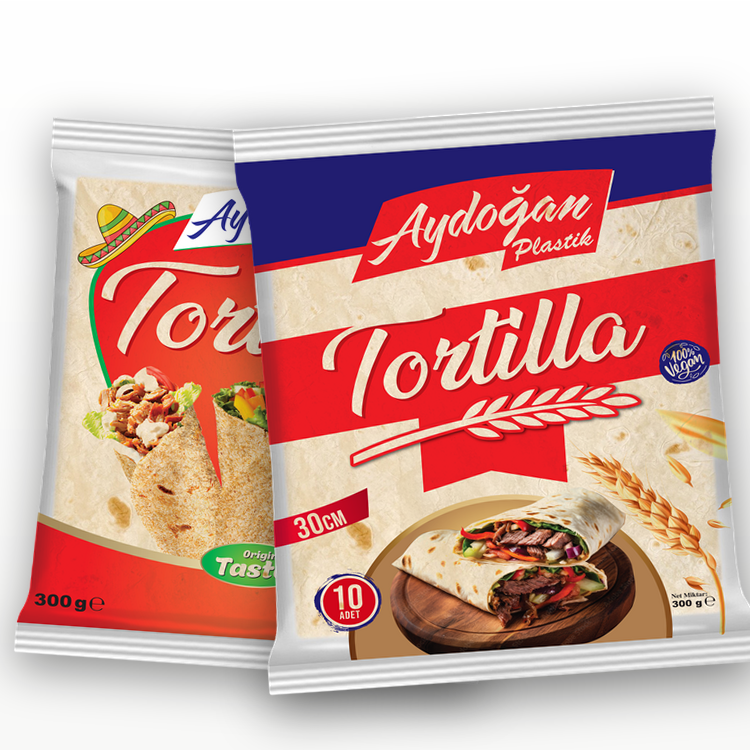
Product Types
- Tortilla (wheat and corn-based)
- Lavash bread
- Yufka and pita bread
- Wrap and doner bread
- Pita and Arabic bread
- Thin-dough ethnic breads
- Industrial HoReCa products
Packaging Formats
- Side-gusseted bags (for stacked products)
- Pillow / flowpack packaging
- Reclosable zipper bags
- Reel-form film (automatic flowpack)
- Micro-perforated breathable bags
High moisture barrier and flexibility preserve the softness of the product.
Film & Material Options
- BOPP/PE, BOPP/CPP — laminated barrier structures
- PET/PE – barrier for extended shelf life
- PA/PE – barrier for extended shelf life
- Metallised structures — light and oxygen barrier
Food-contact safe, manufactured from EU-compliant raw materials.
Tortilla-Flatbread Packaging: Flexible PE Solutions for Wrap and Flatbread Products
Tortillas, lavash, pita, naan, and other flatbread varieties have become global staples, transcending their regional origins to occupy significant shelf space in supermarkets, foodservice distributors, and quick-service restaurant supply chains worldwide. Tortilla-flatbread packaging must address a unique set of challenges: these products are thin, pliable, and prone to drying out, yet they must remain soft and foldable for the end consumer. At the same time, stacked flatbreads exert pressure on the film, demanding puncture resistance and reliable seal performance under compression.
Aydoğan Plastik manufactures polyethylene-based tortilla and flatbread packaging films and bags engineered to preserve product freshness, extend shelf life, and support high-speed automated packaging lines. Our film extrusion technology produces multi-layer PE films with precisely calibrated moisture-barrier and mechanical properties tailored to each flatbread format.
Applications Across the Flatbread Category
Flour & Corn Tortillas
Flour and corn tortillas are the highest-volume product in the flatbread packaging segment. These products are typically stacked in counts of 6, 8, 10, or 12 and sealed in pillow-pack or flow-wrap format on high-speed horizontal packaging machines. The packaging film must deliver consistent seal integrity at production speeds exceeding 100 packs per minute while accommodating the irregular surface texture of tortillas without puncturing.
Moisture management is a defining challenge for tortilla packaging. The film must retain enough moisture to keep tortillas pliable, but excessive moisture retention leads to condensation that promotes mould growth and shortens shelf life. Our PE film formulations achieve an optimised moisture vapour transmission rate (MVTR) that balances these competing requirements, extending ambient shelf life while maintaining the soft, foldable texture consumers expect.
Lavash & Yufka
Lavash and yufka are traditional flatbreads common across Turkey, the Caucasus, and Central Asia. These ultra-thin products are particularly sensitive to moisture loss and require packaging that creates a near-hermetic seal environment. Our lavash packaging films offer superior clarity to showcase the product’s characteristic thinness and translucency, while providing the moisture barrier necessary to prevent the sheets from becoming brittle during shelf storage.
For large-format lavash sheets, oversized bag dimensions are required. Our cutting lines accommodate widths up to 80 cm, enabling single-piece packaging for traditional full-size lavash without folding or trimming the product.
Pita Bread
Pita bread’s distinctive pocket structure creates additional packaging considerations. The inflated pocket traps air, increasing the effective volume of each piece and requiring bags with adequate headspace. Gusseted bag formats are commonly used for pita, expanding to accommodate the product’s three-dimensional profile when filled. Our gusseted flatbread bags maintain dimensional stability on retail shelves, presenting a neat, uniform appearance even when product sizes vary slightly between pieces.
Naan, Chapati & Speciality Flatbreads
Naan and chapati products are often sold fresh with very short shelf lives, or frozen for extended distribution. Fresh naan packaging may incorporate micro-perforation to allow controlled ventilation and prevent sogginess, while frozen naan packaging requires cold-flex PE formulations that maintain film integrity at temperatures down to −30 °C. Speciality flatbreads such as injera, roti, and paratha each have specific thickness, texture, and moisture profiles that influence film selection and bag design.
The growing popularity of international cuisine in European and North American markets has significantly expanded the demand for speciality flatbread packaging. Aydoğan Plastik supports this trend by offering customisable bag dimensions, multi-language printing capabilities, and compliance with international food-contact regulations across multiple export markets.
Technical Specifications
Film Thickness & Material Selection
Tortilla and flatbread packaging films are typically produced in the 25–60 micron range. Lightweight single-stack packs use 25–35 micron films, while heavier multi-stack or club-size packs require 40–60 microns for adequate strength. Our co-extrusion lines produce three-layer and five-layer structures optimised for flatbread applications: the inner layer provides reliable heat-seal performance, the core layer delivers mechanical strength and puncture resistance, and the outer layer ensures high-quality print surface and gloss.
Material options include LDPE for flexibility and optical clarity, LLDPE for puncture and tear resistance, and blended formulations that combine properties for optimal flatbread packaging performance.
Moisture Barrier & Shelf Life Extension
Flatbread shelf life is primarily governed by moisture dynamics. Our films are engineered with controlled MVTR values calibrated to each product category. Tortillas typically require moderate moisture retention, while lavash demands near-complete moisture lockout to prevent brittleness. By adjusting the polymer blend and layer structure, we fine-tune the barrier properties to match each product’s specific requirements.
Seal Performance on High-Speed Lines
Modern tortilla packaging operates at high throughput rates on horizontal flow-wrap machines. Our films are formulated for broad sealing windows—wide temperature and dwell-time ranges that accommodate line-speed variations without seal failures. Contamination-tolerant seal layers handle flour dust and oil residue commonly present on tortilla surfaces, ensuring hermetic closures even in challenging production environments.
Printing & Branding
Up to 8-colour flexo printing transforms functional flatbread bags into compelling brand vehicles. Product imagery, recipe suggestions, nutritional panels, barcodes, and bilingual text are printed with high registration accuracy. Our graphic design team delivers digital mockups for approval before production begins, and lamination options are available for enhanced print protection and premium visual appeal.
For retail-facing products, high-clarity films with glossy finishes maximise product visibility through the packaging, a key purchase driver in the competitive flatbread category.
Production Process
Our integrated facility manages the entire flatbread packaging workflow. Film extrusion produces base films in the required formulation, thickness, and width. Printed orders proceed to the printing station, followed by slitting to specified reel widths. Cutting converts reels into finished bags—flat, gusseted, or wicketed—according to specification.
Every batch undergoes quality control testing for thickness uniformity, seal strength, MVTR, optical clarity, and print accuracy. Finished goods are palletised and dispatched from our warehousing and shipping facility. Visit about us or contact us for project details.
Frequently Asked Questions
What film thickness is used for tortilla packaging?
Typically 25–60 microns. Single-stack packs use 25–35 microns, while multi-stack or club-size formats require 40–60 microns for strength and puncture resistance.
How is moisture managed in flatbread packaging?
Our films are engineered with calibrated moisture vapour transmission rates (MVTR) specific to each product. Tortillas require moderate moisture retention, while lavash demands near-complete moisture lockout to prevent brittleness.
Can large-format lavash sheets be packaged without folding?
Yes, our cutting lines accommodate bag widths up to 80 cm, enabling single-piece packaging for full-size lavash and yufka sheets.
Is the packaging compatible with high-speed flow-wrap machines?
Yes, our films are formulated for broad sealing windows and contamination-tolerant seal layers, ensuring reliable performance on horizontal flow-wrap lines exceeding 100 packs per minute.
Is flexo printing available?
Yes, up to 8-colour flexo printing with high registration accuracy. Digital mockups are provided for pre-production approval. Lamination is available for enhanced durability.
What is the minimum order quantity?
Minimum order quantities vary by size, thickness, and printing requirements. Plain bags have lower minimums; custom-printed orders require higher volumes. Contact our dedicated sales team for specifics.