


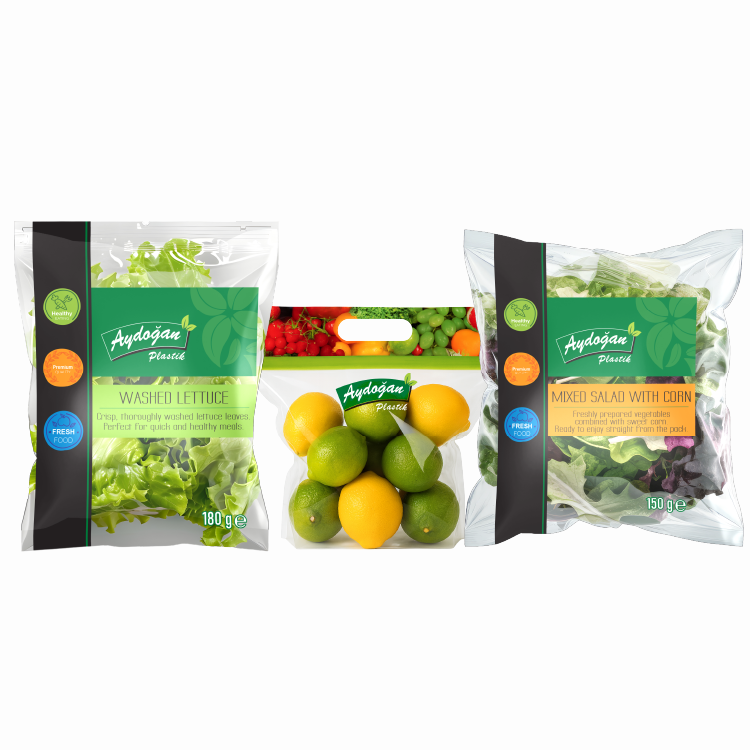
Product Types
- Fresh vegetables (lettuce, spinach, rocket)
- Fresh fruits (apples, pears, grapes)
- Ready-cut salad mixes
- Fresh herbs (parsley, dill, basil)
- Root vegetables (carrots, potatoes, onions)
- Stone fruits and citrus products
- Organic and ready-to-eat fruit and vegetable products
Packaging Formats
- Micro-perforated breathable bags
- Macro-perforated mesh-style bags
- Pillow / flowpack fresh produce packs
- Stand-up doypack salad bags
- Anti-fog transparent structures
- Modified atmosphere (MAP) packaging
Perforation patterns are customised to the respiration rate of each product.
Film & Material Options
- BOPP anti-fog — transparent anti-condensation structure
- LDPE / LLDPE — flexible, puncture-resistant bags
- PA/PE – barrier for extended shelf life
- BOPP/PE — laminated fresh produce structures
- PET/PE – barrier for extended shelf life
- Custom micro-perforated films — shelf-life extension
Gas permeability matched to product respiration preserves freshness.
Fruit and Vegetable Packaging: Breathable PE Films for Fresh Produce Protection
Fresh fruits and vegetables are living products that continue to respire after harvest, consuming oxygen and releasing carbon dioxide, ethylene, and water vapour. Fruit and vegetable packaging must manage this biological activity through controlled atmosphere properties—allowing enough gas exchange to prevent anaerobic spoilage while retaining sufficient moisture to avoid wilting and dehydration. Aydoğan Plastik manufactures polyethylene-based produce packaging films and bags that balance these complex requirements, extending shelf life and reducing food waste across the fresh produce supply chain.
Our film extrusion lines produce micro-perforated, macro-perforated, and non-perforated PE films tailored to the specific respiration rates and moisture needs of each fruit and vegetable variety. From pre-packed salad bags to bulk agricultural sacks, we deliver solutions that keep produce fresh from field to fork.
Applications Across the Fresh Produce Sector
Pre-Packed Retail Produce
Supermarket produce departments increasingly favour pre-packed formats over loose display for reasons of hygiene, convenience, portion control, and reduced in-store waste. Our PE films are used for a wide range of retail produce packs: bags for apples, oranges, and potatoes; flow-wrapped trays for tomatoes, peppers, and mushrooms; and pillow packs for leafy greens, herbs, and bean sprouts. Each product category has distinct respiration and moisture requirements that dictate the film specification.
High-clarity films showcase the product’s freshness—colour vibrancy, surface sheen, and natural shape—through the packaging, a critical visual trigger for consumer purchase decisions. Anti-fog additives prevent condensation droplets from obscuring the product view, maintaining an appetising appearance throughout the cold-chain from packhouse to retail shelf.
Micro-Perforated Films for Respiring Produce
Products with high respiration rates—strawberries, mushrooms, broccoli, leafy salads—require packaging that allows controlled gas exchange to prevent oxygen depletion and carbon dioxide accumulation inside the pack. Our laser-drilled micro-perforated films provide precisely controlled oxygen transmission rates (OTR) and carbon dioxide transmission rates matched to each product’s respiration profile. Perforation hole size (typically 40–200 microns), spacing, and pattern density are calibrated using respiration rate data specific to each commodity, temperature range, and target shelf life.
This modified atmosphere packaging (MAP) approach extends shelf life significantly compared to unsealed or fully sealed alternatives, reducing waste at every stage of the supply chain from packhouse through to consumer refrigerator.
Macro-Perforated & Mesh Bags
Root vegetables (potatoes, onions, carrots), citrus fruits, and other robust produce are often packaged in macro-perforated PE bags or mesh-style formats that provide maximum ventilation. These products are less sensitive to moisture loss and benefit from high airflow that prevents condensation and mould development. Our macro-perforation patterns are designed to maintain bag structural integrity despite the large hole sizes, with reinforced film zones around perforations to prevent tear propagation.
Agricultural & Wholesale Bulk Bags
Growers, wholesale markets, and food processors use large-format PE bags and liners (10–25 kg capacity) for bulk produce transport from field to packhouse or processing facility. These heavy-duty bags require excellent tear resistance and consistent film thickness to withstand the rough handling conditions typical of agricultural operations. Our bulk produce bags are available in perforated and non-perforated formats with optional gussets for volume flexibility and printed branding for farm identity.
Herb & Speciality Produce Packaging
Fresh herbs, microgreens, edible flowers, and speciality produce items are high-value, short-shelf-life products where packaging quality directly impacts both product quality and retail price perception. Our thin-gauge, high-clarity PE films provide the gentle protection these delicate products need, while micro-perforation maintains the controlled atmosphere essential for extending their characteristically brief freshness window.
Technical Specifications
Film Thickness & Material
Produce packaging films range from 15 to 80 microns depending on the application. Lightweight herb and salad bags use 15–25 microns, retail fruit and vegetable packs 25–40 microns, and heavy-duty agricultural bags 40–80 microns. Our co-extrusion lines produce multi-layer structures where the inner layer provides seal performance, the core layer delivers strength, and the outer layer ensures printability and anti-fog function.
LDPE offers excellent clarity and flexibility for delicate produce, LLDPE provides puncture resistance for angular or heavy items, and HDPE adds stiffness for stand-up bag formats. Blended formulations are optimised for each produce category.
Anti-Fog Technology
Condensation inside produce packaging is both a visual and a food-safety problem. Droplets obscure product visibility and create wet surfaces where bacteria and mould thrive. Our anti-fog additives modify the film’s surface energy so that moisture forms a thin, transparent sheet rather than discrete droplets, maintaining clear product visibility while reducing microbial growth risk. Anti-fog performance is maintained throughout the product’s target shelf life.
Seal & Closure Options
Produce bags use a variety of closure methods: heat sealing for flow-wrapped trays, clip closures for wicketed bags, twist ties for bulk bags, and resealable adhesive strips for consumer convenience. Our films are optimised for each closure type, with seal-layer formulations that deliver strong, consistent closures at the speeds demanded by modern produce packaging lines. Quality control testing verifies seal integrity on every batch.
Printing & Branding
Up to 8-colour flexo printing transforms produce bags into brand communication tools. Origin information, variety names, nutritional data, preparation suggestions, barcodes, and PLU codes are printed with high accuracy. Our graphic design team provides digital mockups for pre-production approval. Lamination options are available for enhanced durability on premium produce lines.
Production Process
Our integrated facility manages the entire produce packaging workflow. Film extrusion produces the base film, micro-perforation is applied inline or in a secondary process, printed orders proceed to printing, followed by slitting and cutting. Every batch undergoes quality control testing for thickness, perforation accuracy, seal strength, and OTR values. Finished goods ship from warehousing and shipping. Visit about us or contact us for quotations.
Frequently Asked Questions
How does micro-perforation extend produce shelf life?
Laser-drilled micro-holes allow controlled gas exchange matched to each product’s respiration rate, preventing oxygen depletion and CO₂ build-up that accelerate spoilage.
Can anti-fog properties be added to the film?
Yes, anti-fog additives create a transparent moisture film instead of droplets, maintaining clear product visibility and reducing microbial growth risk.
What film thickness is used for produce packaging?
15–25 microns for herbs and salads, 25–40 microns for retail fruit and vegetable packs, and 40–80 microns for bulk agricultural bags.
Is the film compatible with flow-wrap machines?
Yes, our films are formulated for reliable performance on high-speed horizontal flow-wrap and VFFS packaging lines used in produce packhouses.
Is flexo printing available?
Yes, up to 8-colour flexo printing with digital mockups for approval. Origin labels, brand graphics, and PLU codes are printed with high accuracy.
What is the minimum order quantity?
Varies by format, thickness, and printing requirements. Unprinted products have lower minimums; custom-printed orders require higher volumes. Contact our sales team.