


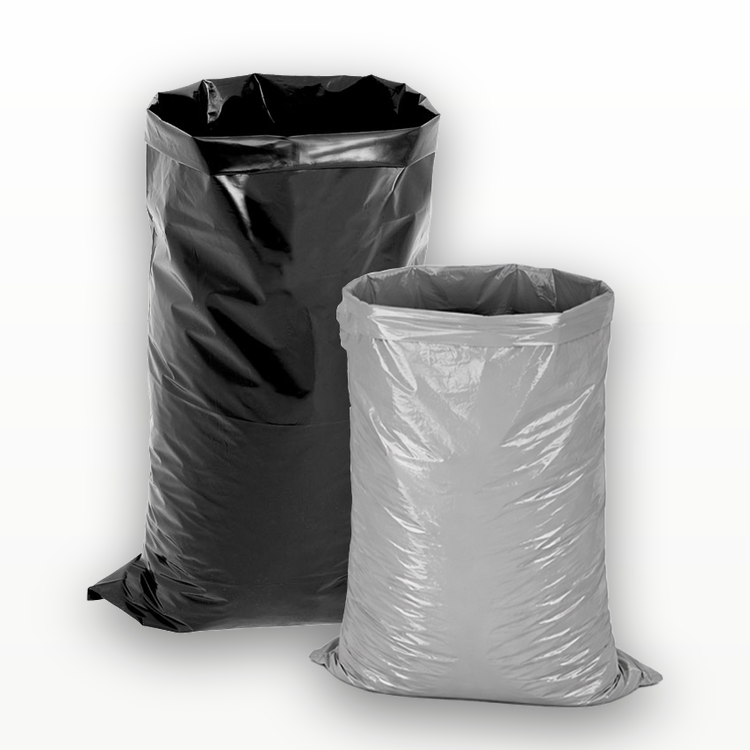
Application Areas
- Household trash bags (kitchen, bathroom, small size)
- Industrial and commercial facility bin liners
- Municipal and public area cleaning bags
- Hotel, restaurant and HoReCa consumable bin liners
- Garden and leaf collection bags
- Construction debris and heavy-waste bags
- Odour-blocking and drawstring premium bags
Technical Features
- Side Gusseted Bottom-Sealed Bag
- Bottom-Sealed Plastic Drawstring Trash Bag
- Large Capacity Side Gusseted Trash Bags for Outdoor Waste Containers
- Odour-eliminator additive premium series
- Reinforced seals for heavy-load durability
HDPE thin films deliver high strength at low gauge, providing raw-material savings.
Film & Material Options
- LDPE / LLDPE — soft touch, tear resistance
- MDPE — balance: flexibility + strength
- HDPE — thin and economical durable structure
- PCR (Post-Consumer Recycled) and PIR (Post-Industrial Recycled) raw materials – sustainable production
- Up to 8-colour flexo printing — branding, campaigns and instructions
High-PCR-content trash bag production significantly reduces carbon footprint.
Trash Bags: Durable Polyethylene Refuse Sacks for Household, Commercial, and Municipal Waste
From kitchen bins to industrial skip liners, trash bags are arguably the most universally consumed polyethylene product on the planet. Every household, restaurant, office, factory, hospital, and public space generates waste that must be contained, transported, and disposed of in bags strong enough to prevent rupture, leak-proof enough to contain liquids, and appropriately sized for the bin systems they serve. Despite their apparent simplicity, refuse sack engineering involves careful balancing of film thickness, material blend, closure mechanism, and cost-per-bag economics—because in a product consumed by the billion, even marginal material optimisation translates into enormous cost and sustainability impact.
Aydoğan Plastik manufactures polyethylene waste collection bag products across the full spectrum of the garbage-bag market. Our film extrusion lines produce films for bin liner, kitchen garbage bag, commercial waste sack, and municipal refuse bag applications in the gauges, colours, and closure formats that household consumers, janitorial services, and waste management operators demand.
Applications Across the Waste Management Chain
Household Kitchen and Bathroom Bags
Consumer trash bags for kitchen, bathroom, and bedroom bins represent the highest-volume segment. Kitchen bags must handle the heaviest and most diverse waste streams—food scraps, liquid residues, broken glass, and sharp can lids—demanding films with reliable puncture resistance and leak-proof bottom seals. Our household kitchen bags use LLDPE-enriched formulations that deliver superior dart-impact resistance compared to pure LDPE or HDPE alternatives, reducing the in-use failures (punctured bags, leaking seals) that generate consumer complaints and brand switching.
Drawstring closure bags—where an integrated cord cinches the bag shut and creates carrying handles—dominate the premium household segment. Our automated drawstring-insertion lines produce bags with consistent cord tension and reliable closure action across high-speed production runs. Tie-top and fold-over closure formats serve the economy segment with simpler, lower-cost alternatives.
Commercial and Office Waste Bags
Offices, retail stores, restaurants, and commercial buildings generate waste in larger bins (60–240 litres) that require proportionally larger and stronger bags. Commercial waste bags in 30–50 micron gauge handle the mixed waste streams of business environments—paper, packaging, food service waste, and general rubbish—with the tear resistance needed to survive rough handling by janitorial staff who often drag filled bags across floors and down corridors to waste collection points.
For waste-segregation programmes, colour-coded bags identify recyclables (blue/green), general waste (black/grey), organic waste (brown), and confidential documents (red/white) at a glance. Our extrusion process produces bags in any colour to match municipal and corporate waste-sorting protocols, with batch-to-batch colour consistency verified through quality control colour-matching procedures.
Industrial and Construction Waste
Heavy-duty industrial waste bags for factories, construction sites, and demolition projects handle materials that would instantly destroy standard household bags—concrete fragments, metal offcuts, wet plaster, paint residue, and heavy manufacturing scrap. Our industrial-grade bags in 60–120 micron film provide the extreme puncture and tear resistance these applications demand, with reinforced seals rated for sustained loads exceeding 30 kg.
Municipal Street and Park Collection
City cleaning crews, park maintenance teams, and public event organisers use large-format bags (100–240 litres) for street sweeping, litter picking, and event-site cleanup. These bags must open quickly for rapid filling during cleanup operations, stand upright in support frames or bins for hands-free filling, and survive transport on municipal collection vehicles without rupture. Our municipal bags include star-sealed or flat-sealed bottom constructions that ensure reliable leak containment when bags hold wet waste from rain-soaked street litter or park debris.
Medical and Clinical Waste
Hospitals, clinics, and dental practices use colour-coded waste bags that segregate clinical waste categories according to healthcare waste regulations. Yellow bags for infectious waste, orange for anatomical waste, purple for cytotoxic waste, and tiger-stripe (yellow/black) for offensive waste are typical colour codes in European healthcare settings. Our medical waste bags are produced in the specific colours, gauges, and printed formats that healthcare waste regulations mandate, with the puncture resistance needed to safely contain sharps boxes, contaminated dressings, and other clinical waste materials.
Garden and Green Waste
Leaf-collection bags, lawn-clipping bags, and garden-waste sacks are seasonal products with strong volume peaks in autumn and spring. These bags must handle wet, heavy organic material (a filled leaf bag can exceed 20 kg) while being easy to tear open at municipal composting facilities. Our garden waste bags balance strength for consumer handling with controlled tear properties for processing-facility opening, using formulations optimised for this dual-requirement application.
Technical Specifications
Film Thickness and Material
Trash bag films range from 6 to 120 microns across the full market spectrum. Ultra-thin economy liners use 6–12 microns, standard household bags 12–25 microns, commercial bags 25–50 microns, and heavy-duty industrial bags 50–120 microns. Our co-extrusion lines produce multi-layer structures where each layer contributes specific performance—puncture resistance, tear strength, elongation, and seal performance—that the bag’s target application demands.
HDPE delivers stiffness and high-volume coverage at minimal material weight, making it the material of choice for economy liners. LLDPE provides the puncture and tear resistance needed for premium kitchen bags handling sharp food waste. LDPE contributes flexibility and quiet handling for indoor applications. Blended formulations balance these attributes for each market segment.
Seal Construction
Bottom-seal construction directly impacts bag reliability. Star seals distribute stress uniformly across the bag bottom, virtually eliminating corner leaks—the most common failure mode for flat-sealed bags containing liquid waste. Flat seals provide maximum bag volume and a cleaner aesthetic for bins with flat bases. Gusseted constructions expand to fit round bins while folding flat for compact packaging. Our cutting lines produce all three seal formats with consistent seal quality across high-speed production runs.
Closure Systems
Drawstring closure provides the premium user experience—one-pull closing with integrated carrying handles. Tie-flap closure uses extended film ears that the consumer twists or ties shut. Flat-top bags are closed by tying a knot in the bag material itself. Our production lines integrate drawstring insertion, tie-flap formation, and flat-top cutting into the bag-forming process, offering all closure formats across the full size and gauge range.
Roll and Flat-Pack Formats
Consumer trash bags are supplied on perforated rolls (10–50 bags per roll) for kitchen-drawer dispensing, or in flat-pack bundles for storage-room inventory. Commercial and municipal bags are typically flat-packed in counted bundles inside cardboard dispensing boxes. Our slitting and packaging lines produce both formats with consistent bag count, reliable perforation tear, and compact packaging that maximises retail shelf density and consumer storage convenience.
Printing and Branding
Up to 8-colour flexo printing adds brand identity, capacity markings, waste-type identification, and environmental messaging to trash bags. For private-label retailers, printed bags carry the store brand across every roll in the consumer’s kitchen—providing sustained brand visibility in a high-frequency repurchase category. Our graphic design team provides mockups integrating drawstring channel, perforation lines, and print-repeat patterns.
Sustainability
Production waste is recycled via our recycling facility. Post-consumer and Post-industrial recycled PE content is available and widely used in the trash bag segment, where recycled content reduces virgin material consumption without compromising essential bag performance. Our recycled-content trash bags carry third-party certification documenting the recycled percentage—a growing requirement from retailers and municipalities committed to circular-economy procurement policies. For guidance, see EUROPEN.
Production Process
Our high-capacity facility manages the complete trash bag production chain: extrusion, printing, slitting, and cutting with drawstring insertion, seal formation, and roll packaging. Every batch passes quality control testing for film thickness, dart impact, seal strength, and drawstring function. Products ship from warehousing and shipping. Visit about us or contact us for volume pricing and private-label consultation.
Frequently Asked Questions
What film thickness is used for household trash bags?
6–12 microns for economy liners, 12–25 microns for standard kitchen bags, and 25–50 microns for premium heavy-duty household bags.
Are drawstring closure bags available?
Yes, integrated drawstring with one-pull closure and carrying handles. Also tie-flap and flat-top alternatives for economy segments.
Can bags be colour-coded for waste segregation?
Yes, any colour for municipal and corporate waste-sorting programmes. Batch colour consistency verified through quality control.
Is recycled content available?
Yes, post-consumer and post-industrial recycled PE with third-party certification. Widely used in the trash bag segment without performance compromise.
What is the minimum order quantity?
Varies by bag size, gauge, closure type, and printing. Private-label programmes and municipal supply contracts are managed with annual scheduling. Contact our team for details.