


Application Areas
- Organic and inorganic fertilizer packaging
- Peat and plant growing medium packaging
- Peat moss and coco peat packaging
- Garden minerals and soil amendments
- Hobby and professional gardening products
- Potting soil retail packaging
- Industrial agriculture raw material bags
Technical Features
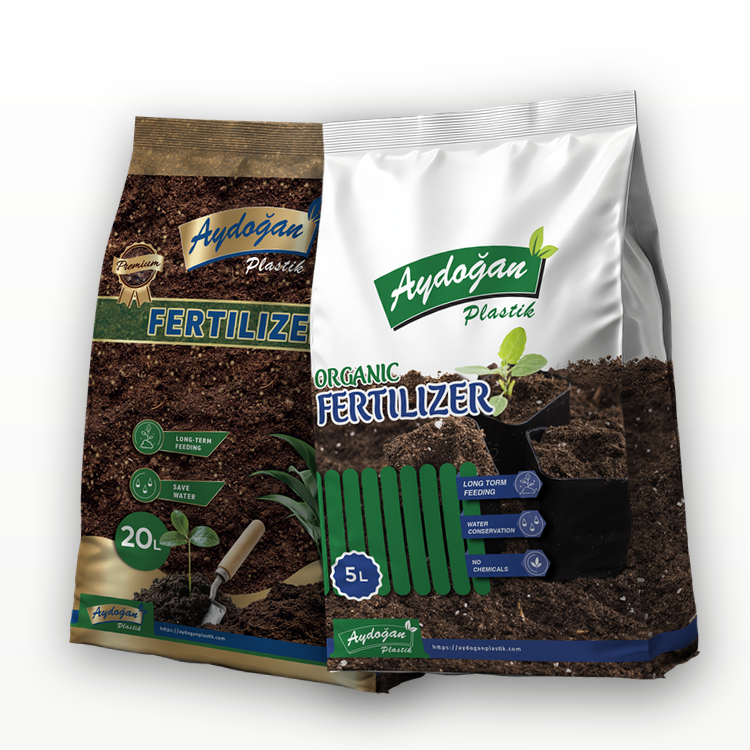
- Capacity from 5 L up to 20 L
- Reinforced seals for heavy-load carrying
- Form-fill-seal (FFS) reel production compatibility
- Micro-perforated structures for ventilation and moisture balance
- Carrying handle or punched-out handle options
Film & Material Options
- LDPE / LLDPE — flexible, durable base structure
- MDPE — high strength at economical gauge
- CoEx multi-layer structures — puncture resistance
- PCR-recycled raw materials — sustainable agriculture
- Up to 8-colour flexo printing — product information and usage instructions
- Inner/Outer layer of the film in different colors conceals content inside
In gardening products, flexo printing reproduces soil and plant imagery in high resolution.
Fertilizer Packaging: Heavy-Gauge Polyethylene Sacks for Agricultural Nutrients and Soil Amendments
The agricultural input sector moves enormous volumes of granular, powdered, and pelleted products—NPK blends, urea, ammonium nitrate, potash, phosphate, organic compost, peat, and speciality micronutrient formulations—from production plants to farms, garden centres, and landscaping operations. Fertilizer packaging must contain products that are dense, chemically aggressive, hygroscopic, and often stored outdoors in conditions that include direct sunlight, rain, temperature extremes, and rough mechanical handling. A 25 kg fertiliser sack that fails in any of these areas—torn film, burst seal, moisture-degraded contents, faded labelling—represents lost product, customer dissatisfaction, and wasted agricultural input that never reaches the soil.
Aydoğan Plastik manufactures polyethylene-based fertiliser sack and soil amendment bag products engineered for the demanding conditions of agricultural supply chains. Our film extrusion lines produce heavy-gauge films with the moisture barrier, chemical resistance, and mechanical toughness that agricultural nutrient packaging, garden centre compost bag, and granular fertiliser pouch applications demand.
Applications Across the Agricultural Input Sector
Granular Fertiliser Sacks
NPK blends, urea prills, ammonium sulphate, and potassium chloride are packaged in 5–50 kg PE sacks for farm, wholesale, and retail distribution. These dense, free-flowing granules concentrate enormous weight on bottom seals—a 50 kg sack exerts sustained pressure that would cause standard packaging seals to creep and fail within days. Our reinforced bottom-seal constructions use wide seal bands and controlled seal temperatures to deliver the creep resistance that heavy fertiliser sacks demand across months of palletised warehouse storage and outdoor field-side stacking.
Granular fertiliser products are also abrasive—hard mineral prills slowly wear away film surfaces from inside the sack during transport vibration. Our LLDPE-enriched multi-layer films distribute this abrasive wear across a thicker, tougher cross-section than single-layer alternatives, extending sack service life through the rough handling conditions typical of agricultural distribution.
Organic Compost, Peat and Soil Mixes
Garden centres, nurseries, and landscaping suppliers sell bagged compost, peat, topsoil, and potting mix in 10–50 litre retail packs displayed outdoors in all weather conditions. These products are moist, heavy, and biologically active—generating gases that can pressurise sealed bags. Our films incorporate controlled ventilation features (micro-perforation or one-way valves) that release internal gas pressure without admitting external moisture, preventing the bag distension and potential rupture that fully sealed compost bags can experience during warm-weather storage.
Speciality and Water-Soluble Fertilisers
Drip-irrigation fertilisers, foliar spray concentrates, and water-soluble NPK blends require packaging with exceptional moisture barrier performance—even minor humidity ingress causes caking, clumping, and dissolution of these highly hygroscopic products. Our films deliver MVTR values calibrated for the most moisture-sensitive fertiliser formulations, keeping products free-flowing and water-soluble from the factory to the farm’s fertigation system.
Seed and Seed-Coating Products
Treated seeds, seed coatings, and seed-fertiliser blends are packaged in PE bags that protect the viability of living biological material. The packaging must exclude moisture to prevent premature germination, block light to prevent phytochrome activation, and provide adequate oxygen exchange to maintain seed respiration at safe levels during storage. Our films balance these competing requirements through multi-layer structures with calibrated MVTR and OTR properties tailored to each seed type’s specific storage physiology.
Professional Turf and Landscape Products
Golf courses, sports fields, municipal parks, and landscape contractors use speciality turf fertilisers, wetting agents, and soil conditioners packaged in 10–25 kg PE bags with professional-grade printed labelling. These products are handled by grounds staff working outdoors, often with gloves—requiring bags with ergonomic carry features (handle cut-outs, grip zones) and tear-resistant film that withstands rough field handling without the care typically given to retail-shelf products.
Technical Specifications
Film Thickness and Material
Fertiliser packaging films range from 60 to 150 microns. Retail garden-centre bags use 60–80 microns, standard agricultural sacks 80–120 microns, and heavy-duty bulk sacks (25–50 kg) 120–150 microns. Our co-extrusion lines produce multi-layer structures with moisture-barrier core layers, and chemical-resistant inner layers that maintain film integrity in contact with aggressive fertiliser chemistries.
LLDPE is the primary resin for fertiliser packaging, delivering the puncture resistance and elongation that heavy, abrasive granular products demand. HDPE blends add stiffness and enhanced moisture barrier for hygroscopic water-soluble formulations. Recycled PE content is available for applications where sustainability credentials complement the agricultural sector’s environmental positioning.
Moisture Barrier and Ventilation
Hygroscopic fertilisers (urea, ammonium nitrate, calcium nitrate) require near-hermetic moisture barrier to prevent caking. Organic products (compost, peat) require controlled gas ventilation to prevent bag pressurisation. Our product range spans both extremes—from high-barrier films with MVTR below 2 g/m²/day to micro-perforated films with controlled gas exchange rates—ensuring the optimal atmosphere management for each product category.
Seal Strength and Load Capacity
Fertiliser sack seals must support loads from 5 kg retail packs to 50 kg industrial sacks without creep failure during months of palletised stacking. Our wide-band seal technology and reinforced bottom-seal constructions deliver the sustained load-bearing performance these heavy applications demand. Quality control testing includes creep-under-load simulation at elevated temperatures that represent worst-case warehouse conditions.
Printing and Branding
Up to 8-colour flexo printing delivers nutrient analysis tables, application rate charts, safety warnings, and brand graphics on fertiliser bags. Our graphic design team ensures layouts comply with fertiliser labelling regulations across target markets. Lamination provides additional print protection for premium garden-centre retail products.
Production Process
Our integrated facility manages the complete fertiliser packaging workflow: extrusion, printing, slitting, and cutting with reinforced seal construction. Every batch passes quality control testing for moisture barrier, seal load capacity, and print durability. Production waste is recycled via our recycling facility. Products ship from warehousing and shipping. Visit about us or contact us for agricultural packaging consultation.
Frequently Asked Questions
What film thickness is used for fertiliser bags?
60–80 microns for garden retail, 80–120 microns for standard agricultural sacks, and 120–150 microns for heavy 25–50 kg bulk sacks.
Can bags handle hygroscopic products like urea?
Yes, high-barrier films with MVTR below 2 g/m²/day keep hygroscopic fertilisers dry and free-flowing throughout storage.
Are ventilated bags available for compost products?
Yes, micro-perforated films and one-way valves release gas pressure from biologically active products without admitting external moisture.
What is the minimum order quantity?
Varies by bag size, gauge, and printing. Seasonal garden-centre and annual agricultural programmes are accommodated. Contact our team for specifics.