


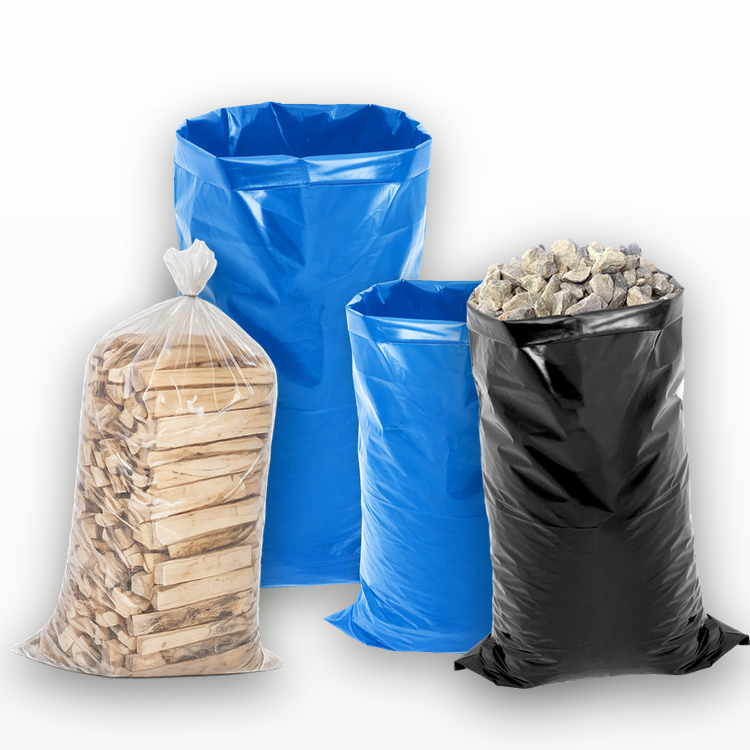
Application Areas
- Construction materials and debris transport
- Agricultural products and post-harvest transport
- Chemical and mineral raw material packaging
- Cement, sand and aggregate industrial packaging
- Animal feed and large-volume feed bags
- Industrial waste collection and transfer
- Heavy-load logistics and shipping packaging
Technical Features
- Single-bag carrying capacity from 25 kg up to 50 kg
- Double-layer reinforced seal welding
- Reinforced mouth and base structure for heavy loading
- Lift-handle option
In heavy-duty bags, seal strength is the most critical parameter determining carrying capacity.
Film & Material Options
- LDPE / LLDPE — flexible, high puncture resistance
- MDPE — high strength at economical gauge
- HDPE — thin film high load-bearing
- CoEx multi-layer structures — superior puncture and tear resistance
- PCR (Post-Consumer Recycled) and PIR (Post-Industrial Recycled) raw materials – sustainable production
- Up to 8-colour flexo printing — product, batch and weight information
PCR&PIR-recycled raw materials can be used in the middle layer of CoEx 3-layer structures.
Heavy Duty Plastic Bags: Extra-Thick Polyethylene Sacks for Demanding Load Applications
When standard packaging fails under extreme weight, rough handling, or harsh storage conditions, heavy duty plastic bags step in as the last line of defence between product integrity and costly damage. Engineered in film gauges from 80 to 200+ microns—three to ten times thicker than conventional packaging films—these industrial strength sacks are designed to contain products that would tear, puncture, or burst through ordinary bags: construction rubble, aggregate materials, heavy machine parts, wet industrial waste, and dense agricultural products. The applications share a common requirement: absolute mechanical reliability under loads and conditions that push polyethylene to its performance limits.
Aydoğan Plastik manufactures extra thick poly bags and reinforced industrial sacks on film extrusion lines engineered for the heavy-gauge output that high-load carrier bags demand. Our multi-layer co-extrusion technology produces films with optimised tear propagation resistance, puncture threshold, and creep behaviour that standard single-layer extrusion cannot achieve at equivalent thickness.
Applications Across Heavy-Duty Sectors
Construction and Demolition Waste
Construction sites generate rubble, broken tiles, concrete fragments, plaster waste, and timber offcuts that are collected in heavy duty bags for disposal or recycling. These materials are heavy, angular, and abrasive—a combination that destroys conventional bags within seconds. Our construction-grade rubble sack products in 120–200 micron film withstand the extreme puncture and tear forces generated by sharp-edged building debris. Multi-layer LLDPE-enriched structures distribute impact energy across the film cross-section, preventing the catastrophic single-point failures that thinner single-layer bags suffer when a concrete shard presses against the film surface.
Site workers filling rubble bags rarely handle them gently—bags are dragged across rough surfaces, thrown onto skips, and stacked on pallets with heavy machinery. Our films are engineered for this abuse, with dart-impact resistance values that exceed industry benchmarks for construction waste containment.
Industrial Manufacturing
Factories, workshops, and processing plants use heavy duty bags for raw material containment, work-in-progress protection, and finished-goods packaging. Metal stampings, cast components, rubber mouldings, and plastic parts are packaged in thick-gauge PE bags that protect products from corrosion, contamination, and mechanical damage during inter-process transport and warehouse storage. VCI (volatile corrosion inhibitor) additive options provide active rust prevention for ferrous metal components sealed inside the bag.
Our heavy duty bags for manufacturing applications are available in custom dimensions matched to specific component sizes, pallet configurations, and automated packaging-line requirements. Cutting lines produce bags from small component pouches (30×40 cm) to full pallet covers (200×250 cm) in gauges that match each application’s weight and handling profile.
Agricultural and Horticultural
Soil, compost, bark mulch, gravel, and sand are sold in heavy duty PE bags through garden centres and agricultural suppliers. These products are dense—a 25 kg bag of soil exerts enormous sustained pressure on bottom seals—and often wet, adding moisture weight and creating humid conditions inside the bag that can degrade weaker film structures. Our agricultural-grade bags use moisture-resistant HDPE and LLDPE blends with reinforced bottom seals rated for sustained loads exceeding 30 kg, ensuring bags survive months of outdoor garden-centre display without seal failure or film degradation.
Waste Management and Environmental Services
Hazardous waste containment, asbestos removal, contaminated soil remediation, and industrial cleanup operations require heavy duty bags that meet specific regulatory requirements for material thickness, colour coding, and labelling. Our heavy gauge waste sack products are available in the gauge specifications, colours (red, yellow, black, clear), and print formats that waste management regulations require across different jurisdictions.
Moving, Storage and Logistics
Furniture wrapping, mattress covers, appliance protection bags, and pallet covers use heavy duty PE film to protect high-value goods during relocation, warehouse storage, and long-distance freight transport. These furniture protection sack applications require films that resist tearing from furniture edges, drawer handles, and appliance corners during the loading, transit, and unloading process. Our films provide the puncture and tear resistance needed for reliable protection of items where a single packaging failure can result in thousands of euros of product damage.
Technical Specifications
Film Thickness and Material
Heavy duty bags range from 80 to 200+ microns. Standard industrial bags use 80–120 microns, construction rubble sacks 120–160 microns, and extreme-duty applications 160–200+ microns. Our co-extrusion lines produce multi-layer structures where the outer layer provides abrasion resistance and print adhesion, the core layer delivers maximum tensile and tear strength, and the inner layer ensures product compatibility and seal performance.
LLDPE is the primary resin for heavy duty applications, providing the superior puncture resistance, elongation at break, and tear propagation resistance that extreme-load bags demand. HDPE blends add stiffness for bags that need to hold their shape during filling. Recycled PE content is available for applications where environmental credentials are valued alongside mechanical performance.
Mechanical Performance
Heavy duty bags are specified by their mechanical properties rather than simply their film thickness. Key performance parameters include dart impact resistance (measured in grams to failure), Elmendorf tear resistance (in both machine and transverse directions), tensile strength at yield and break, and elongation at break. Our quality control laboratory tests all these parameters on every production batch, providing customers with batch-specific test certificates that document the mechanical performance of their bags.
Seal Strength and Construction
Bottom seals on heavy duty bags must withstand enormous sustained loads without creep failure. Our seal technology for heavy-gauge films uses wide seal bars that create broad seal bands (10–15 mm) distributing load across a larger area than standard narrow seals. Double-seal constructions—two parallel seal lines—provide redundancy for critical applications where a single seal failure would cause catastrophic product loss. Seal strength is tested under simulated load conditions that replicate months of stacked warehouse storage.
Printing and Identification
Up to 8-colour flexo printing delivers safety warnings, waste-classification labels, brand logos, and handling instructions on heavy duty bags. Our graphic design team creates layouts that comply with waste management and hazardous materials labelling regulations. Lamination protects printed information from the abrasion and outdoor exposure typical of heavy duty applications.
Production Process
Our integrated facility manages the complete heavy duty bag production workflow: extrusion of heavy-gauge multi-layer film, printing, slitting, and cutting with reinforced seal construction. Every batch passes quality control mechanical testing with batch-specific certificates. Production waste is recycled via our recycling facility. Products ship from warehousing and shipping. Visit about us or contact us for technical consultation and load-rated specifications.
Frequently Asked Questions
What film thickness is used for heavy duty bags?
80–120 microns for standard industrial, 120–160 microns for construction rubble, and 160–200+ microns for extreme-duty applications.
Can bags withstand sharp construction debris?
Yes, multi-layer LLDPE structures provide dart-impact and puncture resistance that exceeds industry benchmarks for rubble containment.
Are colour-coded waste bags available?
Yes, bags are produced in any colour for waste classification systems. Regulatory labelling is printed with compliant formats.
Is printing available?
Yes, up to 8-colour flexo with safety warnings and regulatory labels. Lamination protects print in outdoor conditions.
What is the minimum order quantity?
Varies by bag dimensions, gauge, and printing. Project-specific specifications are quoted individually. Contact our team for details.