


Product Types
- Frozen vegetables and fruits
- Frozen ready meals and dumplings
- Frozen meat, poultry and seafood
- Frozen pastries and dough products
- Frozen pizza and savoury pastries
- Frozen potatoes and fried products
- Industrial and HoReCa frozen foods
Packaging Formats
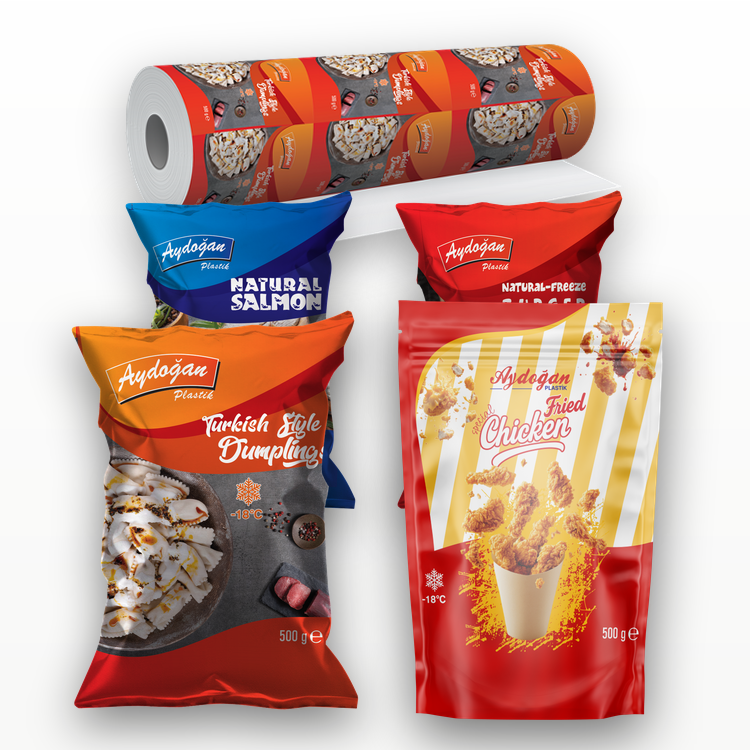
- Pillow / flowpack packaging
- Stand-up doypack pouches
- Vacuum packaging bags
- Reel-form film (high-speed flowpack)
Film structures retain flexibility and crack resistance at –18 °C and below.
Film & Material Options
- PA/PE — frozen vacuum, superior puncture resistance
- PET/PE, PET/CPP — high barrier and stiffness
- PET/MET.PET/PE, PA/MET.PET/PE – metallised structures for long term barrier
- LDPE low-temperature films — economical frozen solutions
Films engineered for stable seal performance throughout the cold chain.
Frozen Food Packaging: Cold-Chain PE Film Solutions for Maximum Product Protection
The global frozen food market spans vegetables, fruits, ready meals, seafood, meat portions, and desserts—a diverse product range united by a single packaging imperative: maintaining integrity and barrier performance at sub-zero temperatures. Frozen food packaging must resist cracking in blast freezers, preserve moisture to prevent freezer burn, deliver reliable seals despite ice crystal formation, and present an attractive retail appearance in open-top freezer cabinets. Aydoğan Plastik manufactures polyethylene-based frozen food packaging films and bags that meet every one of these cold-chain challenges.
Our film extrusion lines produce multi-layer PE films formulated with cold-flex polymers that maintain flexibility, seal strength, and barrier properties from −40 °C blast-freezer conditions through ambient retail handling. Whether the application calls for stand-up pouches for premium frozen vegetables or heavy-gauge bags for industrial IQF products, we deliver tailored solutions backed by comprehensive quality assurance.
Applications Across the Frozen Food Sector
Frozen Vegetables & Fruits
Individually quick frozen (IQF) vegetables and fruits—peas, corn, berries, mango chunks—are the highest-volume segment in frozen food packaging. These products are free-flowing when frozen but can clump together during temperature fluctuations in the supply chain. Our PE films provide the moisture barrier needed to minimise ice crystal migration between product pieces, reducing clumping and maintaining the free-pour convenience consumers expect.
Retail bags for frozen vegetables are typically produced in pillow-pack or stand-up pouch formats with resealable zipper closures. Our films are compatible with inline zipper application systems, allowing consumers to reseal the bag after each use—extending product quality across multiple servings and reducing food waste.
Frozen Ready Meals & Prepared Foods
Frozen ready meals, pizza, spring rolls, and prepared food components are packaged in a variety of formats including flow-wrap, tray-lidding, and pillow-pack bags. These products often contain sauces, gravies, and high-moisture components that can migrate to the seal zone during freezing, challenging seal integrity. Our contamination-tolerant seal formulations deliver reliable closures despite the presence of food residue, oils, and moisture on sealing surfaces.
For microwave-compatible frozen food packaging, our films can be formulated with controlled vent features that allow steam to escape during reheating, preventing package rupture while keeping the product contained.
Frozen Seafood
Fish fillets, shrimp, calamari, and other seafood products are among the most demanding frozen food packaging applications. These products are wet, irregularly shaped, and often packed with a protective ice glaze that adds moisture to the package environment. Our PE films resist moisture penetration from both inside and outside the package, maintaining product quality and preventing the fishy odour transfer that occurs when barrier performance is inadequate.
Vacuum-pack compatible PE films are available for premium seafood applications where oxygen exclusion is essential to prevent lipid oxidation and colour degradation in fatty fish species such as salmon, mackerel, and sardine.
Frozen Meat & Poultry
Bulk meat portions, chicken parts, minced meat, and processed meat products require packaging that withstands the weight and sharp bone edges of frozen meat. Our heavy-gauge films (60–100 microns) provide the puncture resistance needed for bone-in products, while multi-layer barrier structures minimise oxygen transmission to prevent surface discolouration and off-flavour development during frozen storage periods that may extend to twelve months or longer.
Frozen Desserts & Pastries
Frozen cakes, pastries, ice cream novelties, and dessert components require packaging that protects delicate shapes and decorative finishes from mechanical damage during cold-chain handling. Our films combine cold-flex formulations with controlled stiffness to create a protective envelope that absorbs impact without cracking. High-clarity options allow consumers to appreciate product presentation through the packaging—a significant purchase driver in the premium dessert category.
Technical Specifications
Cold-Flex Performance
Standard PE films become brittle below −10 °C, leading to cracking during handling and transport. Our frozen-grade formulations incorporate metallocene LLDPE and speciality elastomers that maintain flexibility and impact resistance down to −40 °C. This cold-flex performance is verified through standardised cold-crack testing in our quality control laboratory, ensuring every batch meets the rigorous demands of blast-freezing and cold-chain logistics.
Film Thickness & Structure
Frozen food packaging films range from 30 to 120 microns. Lightweight IQF vegetable bags use 30–50 microns, standard retail frozen food packs 50–80 microns, and heavy-duty industrial formats 80–120 microns. Our co-extrusion lines produce three-layer and five-layer structures with cold-flex inner layers, high-strength core layers, and print-optimised outer layers.
Moisture Barrier & Anti-Fog
Freezer burn—surface dehydration caused by moisture migration from product to package headspace—is the primary quality defect in frozen foods. Our multi-layer films provide low MVTR values that minimise this migration, keeping products at their target moisture content throughout frozen storage. Anti-fog additives incorporated into the inner film layer prevent condensation droplets from forming when packages move between temperature zones, maintaining clear product visibility in retail freezer displays.
Seal Technology
Sealing frozen food packages is complicated by ice crystals, food residues, and condensation on seal surfaces. Our seal-layer formulations achieve strong, hermetic closures under these challenging conditions. Hot-tack performance is optimised for high-speed packaging lines where seal dwell times are minimal and products are still partially unfrozen during packaging.
Printing & Branding
Up to 8-colour flexo printing delivers vivid product imagery, cooking instructions, nutritional panels, and brand graphics that drive purchase decisions at the freezer aisle. Our graphic design team provides digital mockups for pre-production approval. Lamination options protect print quality from the abrasion and moisture exposure inherent in frozen food distribution.
Production Process
Our integrated facility manages the entire frozen food packaging workflow. Film extrusion produces cold-flex base films, printed orders proceed to printing, followed by slitting and cutting. Every batch undergoes quality control testing for cold-crack resistance, seal strength at frozen temperatures, MVTR, and print quality. Finished goods ship from our warehousing and shipping facility. Visit about us or contact us for project-specific quotations.
Frequently Asked Questions
What temperature range can the packaging withstand?
Our frozen-grade PE films maintain flexibility and seal integrity from −40 °C through to ambient temperatures, covering blast freezing, cold-chain transport, and retail display.
How is freezer burn prevented?
Multi-layer films with low MVTR values minimise moisture migration from product to headspace. Combined with hermetic seals, this prevents the surface dehydration that causes freezer burn.
Can anti-fog properties be added?
Yes, anti-fog additives in the inner film layer prevent condensation droplets, keeping products clearly visible in open-top freezer cabinets.
Is the film compatible with high-speed packaging lines?
Yes, our films are optimised for hot-tack performance on high-speed horizontal and vertical form-fill-seal machines used in frozen food production.
Is flexo printing available?
Yes, up to 8-colour flexo printing with digital mockups for pre-production approval. Lamination protects print quality through cold-chain handling.
What is the minimum order quantity?
Minimum quantities vary by format, thickness, and printing requirements. Unprinted products have lower minimums; custom-printed orders require higher volumes. Contact our sales team for specifics.