


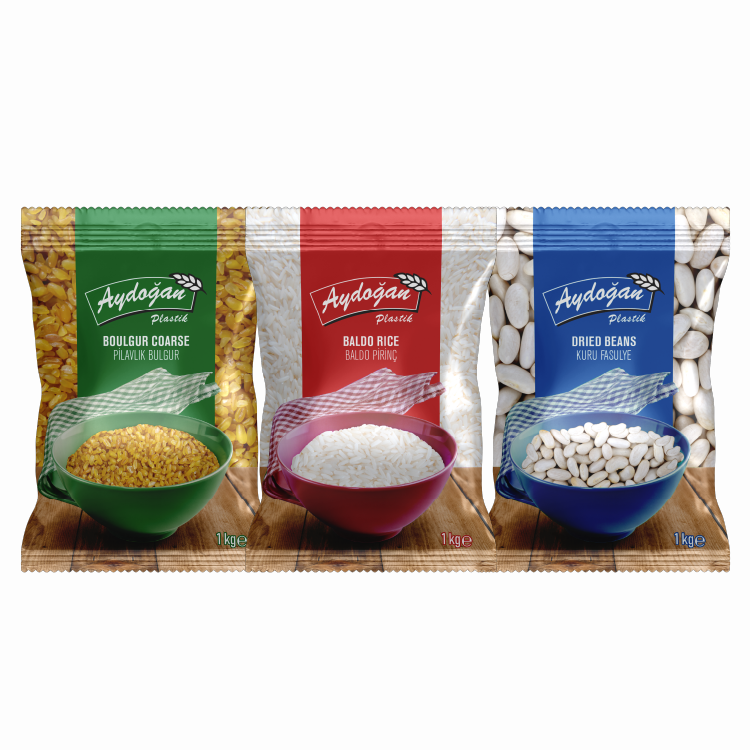
Product Types
- Pulses (lentils, chickpeas, beans)
- Rice, bulgur, buckwheat
- Pasta, noodles, vermicelli
- Flour, semolina, starch
- Granulated products and grains
- Breakfast cereals
- Industrial and retail dry food products
Packaging Formats
- Pillow / flowpack packaging
- Doypack stand-up pouches
- Heavy-duty bags (5–25 kg industrial)
- Reclosable zipper bags
- Reel-form film (automatic filling lines)
Balanced moisture barrier and tear resistance through tailored material selection.
Film & Material Options
- LDPE / LLDPE — durable base bag structure
- BOPP/PE — transparent, high print quality
- PET/PE — barrier for extended shelf life
- BOPP/CPP — visibility and moisture protection
- PA/PE – barrier for extended shelf life
- Multi-layer laminated structures — heavy-duty industrial
Food-contact safe, compliant with EU regulations.
Dry Food Packaging: Moisture-Proof PE Film Solutions for Extended Shelf Life
Pasta, rice, flour, cereals, legumes, couscous, and other dry food staples form the backbone of household pantries and foodservice kitchens worldwide. These products share a common vulnerability: moisture ingress causes clumping, mould growth, and insect infestation, turning a shelf-stable product into an unsaleable one. Dry food packaging must deliver an effective moisture barrier combined with mechanical durability to protect products through manufacturing, distribution, retail display, and extended home storage. Aydoğan Plastik manufactures polyethylene-based dry food packaging films and bags that address these requirements with precision-engineered multi-layer film structures.
Our film extrusion lines produce PE films in a range of thicknesses, material blends, and barrier configurations tailored to the specific needs of each dry food category. From lightweight retail pouches for premium organic grains to heavy-duty sacks for industrial flour distribution, we provide end-to-end packaging solutions backed by rigorous quality management systems.
Applications Across the Dry Food Sector
Pasta & Noodles
Pasta packaging must accommodate a wide range of shapes—from long spaghetti and linguine to short penne and fusilli—each with different packing densities and mechanical stress profiles. Long-cut pasta can puncture thin films at sharp ends, while short-cut varieties settle and shift during transport, stressing seal lines. Our LLDPE-enriched films provide the puncture resistance needed for long-cut formats and the seal reliability required for heavier short-cut packs. Transparent films showcase product shape and colour, a key differentiator in the competitive pasta aisle.
Rice & Grains
Rice, bulgur wheat, quinoa, and speciality grains are dense products that place significant weight on bag seals and film surfaces. A 1 kg retail rice bag exerts substantially more pressure per square centimetre on its bottom seal than an equivalent-volume cereal box. Our heavy-duty seal formulations withstand these loads without creep or seal failure, even during prolonged shelf storage. For premium basmati and jasmine rice brands, high-clarity films with gloss finishes create a quality perception that justifies premium pricing.
Flour & Baking Ingredients
Flour packaging presents a unique challenge: ultra-fine powder particles migrate into every gap, including the seal zone. Conventional seal layers can fail when flour dust contaminates the sealing surface, resulting in open seals and product leakage. Our contamination-tolerant seal formulations deliver reliable hermetic closures even with significant flour dust present—a critical performance attribute for high-speed flour packaging lines where perfect seal-area cleanliness is practically impossible to maintain.
Baking ingredients such as sugar, baking powder, and cocoa powder share similar fine-particle challenges and benefit from the same contamination-tolerant sealing technology.
Breakfast Cereals & Muesli
Cereal and muesli products are light, voluminous, and mechanically fragile. The packaging must cushion the product against crushing during transport while providing the moisture barrier necessary to maintain crispness. Our PE films offer the flexibility to conform to irregular product volumes without excessive dead space, while multi-layer barrier structures lock out the moisture that turns crispy cereals into stale, soft clumps.
Legumes & Pulses
Dried beans, lentils, chickpeas, and split peas are dense, heavy products with angular shapes that can stress film surfaces during handling and transport. Packaging for legumes requires both high tensile strength and superior puncture resistance to avoid bag failure under stacking loads. Our co-extruded films distribute mechanical loads across multiple layers, preventing single-point failures that could lead to bag rupture during warehouse handling, pallet stacking, and retail shelf storage. Clear films are standard in this segment, allowing consumers to inspect product quality, colour uniformity, and cleanliness before making a purchase decision.
Technical Specifications
Film Thickness & Material
Dry food packaging films range from 25 to 100 microns depending on the application. Lightweight retail packs for cereals and small grain pouches use 25–40 micron films, standard 500 g–2 kg packs for pasta, rice, and legumes use 40–70 microns, and heavy-duty industrial sacks for flour and bulk grains require 70–100 microns. Our co-extrusion lines produce three-layer and five-layer structures with optimised seal, strength, and barrier layers.
Material choices include LDPE for flexibility and clarity, LLDPE for puncture resistance and seal integrity, and HDPE for moisture barrier and stiffness. Custom blends are formulated to match each product’s density, shape, and shelf-life requirements.
Moisture Barrier Performance
The primary shelf-life determinant for dry foods is moisture ingress. Our multi-layer films deliver low moisture vapour transmission rates (MVTR) calibrated to each product category. Hygroscopic products like flour and baking ingredients demand the lowest MVTR values, while less sensitive products like pasta can tolerate slightly higher transmission rates. Film barrier performance is verified through quality control testing on every production batch.
Seal Integrity Under Load
Dense dry food products place continuous static load on bottom seals during shelf storage. Our seal-layer formulations are engineered for high creep resistance—maintaining seal strength over months of sustained pressure without peeling or weakening. This is particularly important for heavy rice and legume packs stored on retail shelves in warm climates where heat can soften conventional seal materials.
Printing & Branding
Up to 8-colour flexo printing delivers the visual impact that dry food brands need to compete on crowded retail shelves. Cooking instructions, nutritional panels, origin stories, recipe suggestions, and brand imagery are printed with high registration accuracy. Our graphic design team prepares digital mockups for pre-production approval. Lamination enhances print durability and adds premium tactile finishes.
Production Process
Our integrated facility manages the complete dry food packaging workflow. Film extrusion produces the base film, printed orders proceed to printing, followed by slitting and cutting to finished formats. Every batch undergoes quality control testing for thickness, seal strength, MVTR, and print accuracy. Our testing protocols include accelerated shelf-life simulation and hot-tack performance verification at line-speed conditions. Finished goods ship from our warehousing and shipping facility. Visit about us or contact us for project-specific details and lead time estimates.
Frequently Asked Questions
What film thickness is recommended for dry food packaging?
It depends on the product: 25–40 microns for lightweight cereals, 40–70 microns for standard pasta and rice packs, and 70–100 microns for heavy-duty flour sacks.
How does the packaging prevent moisture ingress?
Multi-layer co-extruded films with low MVTR values provide an effective moisture barrier. Film formulation is tailored to each product’s specific moisture sensitivity.
Can flour dust in the seal area cause seal failures?
No, our contamination-tolerant seal-layer formulations ensure hermetic closures even when fine flour dust is present in the seal zone.
Are the films food-contact safe?
Yes, all films intended for direct food contact are manufactured from food-grade certified raw materials and comply with applicable food safety regulations.
Is flexo printing available?
Yes, up to 8-colour flexo printing with digital mockups for approval. Lamination options are available for enhanced durability and premium finishes.
What is the minimum order quantity?
Minimum quantities vary by format, thickness, and printing. Unprinted standard products have lower minimums; custom-printed orders require higher volumes. Contact our team for details.