


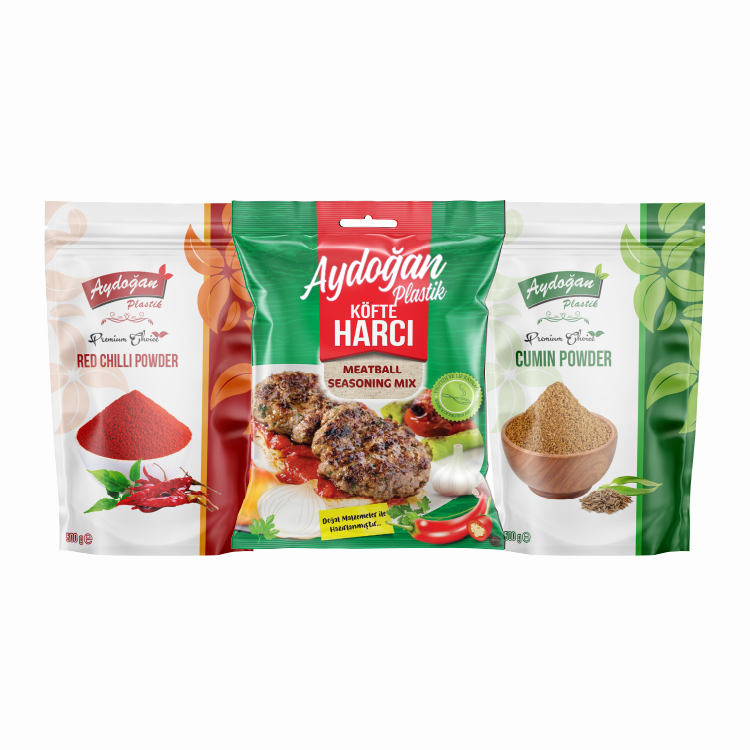
Product Types
- Ground spices (paprika, black pepper, cumin)
- Granular and leaf spices
- Mixed spice blends
- Seasonings and sauce powders
- Dried herbs (thyme, basil, mint)
- Industrial and retail spice products
- Organic and private label spices
Packaging Formats
- Zipper-lock stand-up pouches
- Pillow / flowpack packaging
- Single-use sachet packs
- Doypack stand-up pouches
- Reel-form film (for automatic filling)
High-barrier structures are preferred to prevent aroma loss.
Film & Material Options
- PET/MET.PET/PE — metallised high-barrier
- PET/PE – barrier for extended shelf life
- PA/PE – barrier for extended shelf life
- BOPP/CPP — transparent product display
- PA/ALU/PE — for industrial packaging
- PET/MET.BOPP/PE — premium design options
Protects spice freshness by shielding from light and moisture for extended periods.
Spice and Seasoning Packaging: Aroma-Preserving PE Film Solutions
Spices and seasonings are among the most aroma-sensitive products in the food industry. Ground pepper, paprika, cumin, turmeric, dried herbs, and seasoning blends lose their potency rapidly when exposed to light, oxygen, and moisture. Spice and seasoning packaging must therefore deliver an effective barrier against all three degradation factors while maintaining visual shelf appeal and compatibility with high-speed filling equipment. Aydoğan Plastik manufactures polyethylene-based spice packaging films and bags that protect volatile flavour compounds from production through to the consumer’s kitchen.
Our film extrusion lines produce multi-layer PE films engineered for the unique demands of spice packaging—combining moisture barrier, mechanical strength, and excellent printability in a single flexible structure. Whether the application calls for small sachets, retail pouches, or bulk industrial bags, we provide tailored solutions that preserve product integrity across the entire supply chain.
Applications Across the Spice Industry
Retail Spice Pouches
Consumer-facing spice packaging must balance product protection with strong shelf presence. Printed stand-up pouches, pillow packs, and three-side-seal sachets are the dominant formats in retail spice merchandising. Our PE films deliver the clarity needed to showcase product colour—a critical purchase driver for spices—while providing the moisture barrier that prevents caking and clumping in hygroscopic products like salt blends, garlic powder, and onion flakes.
For premium spice brands, matt-finish and metallic-effect film options create a distinctive on-shelf appearance. Lamination with PET or BOPP outer layers adds structural rigidity and enhances print vibrancy, resulting in packaging that communicates quality before the consumer even opens the product.
Single-Serve Sachets
Individual portion sachets for foodservice, airline catering, and hospitality applications demand precise filling accuracy and reliable sealing at very high production speeds. Our thin-gauge PE films (20–35 microns) are formulated for consistent hot-tack performance on vertical form-fill-seal (VFFS) machines, enabling sachet production rates of several hundred units per minute without seal failures or product contamination in the seal area.
Sachet packaging for ground spices presents particular challenges: fine powder particles migrate into the seal zone and can compromise seal integrity. Our contamination-tolerant seal-layer formulations ensure hermetic closures even when spice dust is present, a critical reliability factor for large-scale foodservice operations.
Bulk & Industrial Spice Packaging
Spice processors, blending houses, and food manufacturers purchase raw spices in bulk quantities ranging from 5 kg to 25 kg. Bulk spice bags require heavy-gauge films (60–120 microns) with high tear and puncture resistance to withstand the weight of dense spice products. These bags must also provide an effective moisture barrier to prevent caking during warehouse storage periods that may extend to several months.
Our bulk spice packaging solutions include flat bags, gusseted bags, and valve-mouth bags for automated filling systems. Block-bottom formats are available for products that need to stand upright on pallets during storage and display. For temperature-sensitive spice extracts and oleoresins, our films can be formulated with enhanced heat resistance to withstand warm-fill processes without seal distortion or film deformation.
Seasoning Blends & Marinades
Pre-mixed seasoning blends, dry marinades, and coating mixes often contain ingredients with different particle sizes—coarse salt crystals alongside fine herb powders—which can cause segregation during transport. Our packaging films offer controlled static properties that help maintain blend homogeneity within the package. For wet marinades and paste-form seasonings, multi-layer films with enhanced chemical resistance prevent flavour scalping and ingredient migration into the film structure.
Technical Specifications
Film Thickness & Material
Spice packaging films are produced in the 20–120 micron range depending on the application. Sachets use 20–35 microns, retail pouches 35–60 microns, and bulk bags 60–120 microns. Our co-extrusion lines produce three-layer and five-layer structures where each layer serves a distinct function: the inner seal layer ensures reliable closure, the core layer provides mechanical strength and barrier properties, and the outer layer offers a high-quality print surface.
LDPE provides excellent clarity and flexibility, LLDPE contributes puncture resistance and seal strength, and HDPE adds stiffness and enhanced moisture barrier. Blended formulations allow precise tuning for each spice product’s specific requirements.
Moisture & Aroma Barrier
Moisture ingress causes spices to cake, clump, and lose free-flowing properties—a critical quality defect for both retail and industrial users. Our multi-layer films deliver low moisture vapour transmission rates (MVTR) that keep hygroscopic spice products dry and free-flowing throughout their shelf life. For aroma preservation, the film structure minimises the escape of volatile essential oils that give spices their characteristic flavour and fragrance.
Light Protection
UV radiation accelerates the degradation of colour pigments in spices—particularly paprika, turmeric, and saffron. Opaque, metallic, or UV-barrier film options protect light-sensitive spice products from photodegradation. White, black, and custom-colour opaque films are available, as are metallised laminate structures that combine total light barrier with premium visual appeal.
Printing & Branding
Up to 8-colour flexo printing delivers vibrant graphics that make spice products stand out in competitive retail environments. Product photography, recipe suggestions, origin information, ingredient lists, and regulatory text are printed with precise registration. Our graphic design team prepares digital mockups for pre-production approval, ensuring colour accuracy across every production run.
For spice brands targeting international markets, multi-language printing and region-specific regulatory compliance (EU food information regulation, FDA labelling requirements) can be incorporated into the packaging design.
Production Process
Our integrated production facility manages the complete spice packaging workflow. Film extrusion produces the base film, printed orders proceed to printing, followed by slitting and cutting to finished bag formats. Lamination is applied where multi-material structures are specified.
Every batch undergoes quality control testing for thickness uniformity, seal strength, MVTR, and print accuracy. Finished products are dispatched from our warehousing and shipping facility. Visit about us or contact us for project-specific information.
Frequently Asked Questions
What film thickness is recommended for spice packaging?
It depends on the application: 20–35 microns for single-serve sachets, 35–60 microns for retail pouches, and 60–120 microns for bulk industrial bags.
How is moisture barrier performance achieved?
Multi-layer co-extruded films with low MVTR values keep hygroscopic spice products dry and free-flowing. Film formulation is tuned to each product’s specific moisture sensitivity.
Can the packaging protect spices from light degradation?
Yes, opaque, metallic, and UV-barrier film options are available to protect light-sensitive spices such as paprika, turmeric, and saffron from photodegradation.
Is the film suitable for high-speed VFFS machines?
Yes, our thin-gauge films are formulated for consistent hot-tack performance on vertical form-fill-seal machines operating at several hundred sachets per minute.
Can spice dust in the seal area cause seal failures?
Our contamination-tolerant seal-layer formulations ensure reliable hermetic closures even when fine spice powder is present in the seal zone.
What is the minimum order quantity?
Minimum quantities vary by bag format, film thickness, and printing requirements. Unprinted standard products have lower minimums; custom-printed orders require higher volumes. Contact our experienced sales team for details.